
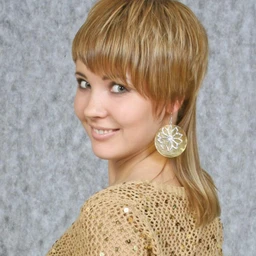
I cannot believe it, I'm already 42 years old. Time is so relentlessly fleeting! But I have nothing to grieve about. Life is given to us only once, so it must be lived in such a way that in old age one regrets what one has done rather than what one never dared to do. My life has turned out so that I feel like a perfectly happy person!
Everything I so wanted and strove for has come true. I have a large, close-knit family: a loving husband and three children. The eldest — Zhanna — is about to turn 18. She can't wait for her coming of age; she is so eager to become independent and self-sufficient. Zhanna reminds me of myself in my youth: I too chafed under my parents' guardianship.
My mother once had the wisdom to leave me to my own devices. And I simply dreamed of adventures! So after my 18th birthday I decided to take part in the then-popular IEC program "Work and Travel USA", to immerse myself for a whole four months in a world that was then different for me, in another culture. I remember those first four months abroad changed me — not so much outwardly as inwardly. They actually became an important life experience, forcing me to look at familiar things from a different angle...
The next year I again decided to take part in the program, paying for it with MY OWN money, which at that time was especially important to me. The financial independence I first achieved in the USA gave me a feeling of astonishing freedom. And that became my main incentive.
In my final year at the institute I hesitated about another trip, because a turning point had come in my life when I had to decide what to do next. There were less than two weeks left until the end of registration for the program, and I was still wavering in my decision. Chance helped: IEC, on the occasion of its 20th anniversary, announced an essay contest on the theme "IEC-2029", the winner of which — the best "futurologist" — would receive a prize: a free trip under the "Work and Travel USA" program. At that time I was actively involved in journalism and, despite the fact that it was only a hobby, my articles were often printed in youth newspapers, and after some time I even had my own column in the local paper — "Interviews with the Stars." So you could say I had some practice with the pen by then.
It's funny to recall now, but back then I tackled the essay with such zeal, deciding to try my luck: if I won the contest — I'd go, if not — so be it.
I reread countless sources with all kinds of predictions about the future, studied dozens of yet-unrealized scientific projects containing fundamentally new technical developments; I couldn't sleep at night because of the whirlwind of thoughts spinning in my head...
One fine day the Muse took pity on me: she sat down beside me and whispered the future to me: I wrote the essay in one sitting. And fate smiled on me after all! I won the contest and sighed with relief: now I knew what I would do next, the uncertainty was gone! I AM FREE!!!
Now, 19 years later, it's frightening even to think what would have happened if I had not paid attention to that very contest and had not won it. After all, I would not have gone to the USA again, would not have earned enough money to pay for correspondence studies at the faculty of journalism, would not have been able to regain student status and take part in the IEC "Work and Travel France" program, would not have met my future husband Jean in France in the summer of 2011, and our children would not have been born. And there are many more such "would-nots"...
Of course, much of what I wrote in the essay back then did not come true. It's easy to indulge in fantasy, to write that in 19 years people would drive cars with solar panels, be able to read other people's thoughts and cover enormous distances at the speed of light, but progress is not as fast as we might perhaps wish...
But...
By 2029 Russia had in fact regained its former geopolitical influence in the world. It became one of the superpowers alongside India and China. Russian became a language of international importance. And despite all the efforts of pro-Western figures in politics, culture and the media, Russia preserved its identity. Fools remained (how could it be without them? boring! ), but the roads, I should note, became significantly better. The famous Russian mentality was not broken: Russians still rely on "avos'" and conquer the world with their adventurism. The phenomenon of the Russian person's "fifth point", endowed by nature with a greater attraction to adventure than that of any other nation, is seriously studied by meticulous German researchers. Meanwhile Russian scientists make discovery after discovery. And now it no longer matters who first landed on the Moon: the Russians or the Americans, because the first base there was built by OURS. And after the space tourism industry developed to the point where any healthy person could buy a ticket to space for a certain sum of money, it was the Russians who first spoke of building interplanetary tourist stations.
All these years the Russian economy gathered momentum rapidly and rose to first place in per capita income. People of retirement age, whose youth was spent behind the USSR's "Iron Curtain", gained the opportunity to travel the world! The economies of many countries began to depend precisely on Russia. Moscow became a global financial center. People started to take an interest in Russia.
Global disarmament, despite all the skeptics' forecasts, bore fruit: the arms race gradually subsided, open military conflicts became rarer, and the threat of terrorism decreased. Strict restrictions on the storage and carrying of weapons were introduced in all countries of the world. Life became safer. People became calmer.
By 2029 most travel agencies in the world were forced to close due to fierce competition with IEC, which began actively offering a new tourist service: vacation exchange.
Now IEC branches operate in more than 100 countries worldwide, which opens up virtually unlimited possibilities for it. Thanks to the international information database that was created, any family wishing to spend a two-week vacation, for example, in the Maldives and turning to IEC can hope to be matched with a Maldivian family who in turn have long dreamed of visiting Russia — an exchange will take place.
Travel, by the way, has become easier and more convenient: no one thinks about the language barrier anymore. Scientists invented a series of tablets called "Polyglot." One such "polyglot pill" works for 24 hours, giving any person the ability to begin to understand and speak the foreign language they need. To universal delight, and especially for the type of Earthlings known as "Masha-the-scatterbrain", by 2029 the visa regime and document flow had been substantially simplified. All the necessary information about every inhabitant of the Earth can long since be obtained from a microchip implanted at birth. During one's life additional information is simply entered onto the chip, for example: graduated from an institute — diploma grades in the form of an electronic table are recorded on this device; got married — an electronic stamp on the chip; children were born — new data are recorded... Thanks to this invention there is less tedious paperwork and the bureaucratic apparatus of many countries has been significantly reduced.
All these years IEC was ahead of the rest of the world! According to the authoritative magazine Forbs, by the end of 2029 its success and influence could perhaps be compared to that of companies like Apple or Microsoft in the distant 2010.
IEC invited the best minds to cooperate. The results were not long in coming: its specialists developed a special service for people limited in their physical and mental abilities, those who for one reason or another could not move or were paralyzed; those who suffered from Down syndrome; those who were terminally ill... For these people IEC offered a virtual journey to a virtual world. The project's authors were inspired by James Cameron's old film "Avatar." The principle is simple: a person lies down in a capsule, sets body proportions, eye and hair color, etc., chooses a destination in the virtual world and, arriving there, communicates with others like them.
About five years ago IEC began offering a round-the-world trip...
I am 42 years old. I worked as a journalist for 20 years and visited more than 78 countries. In addition to English I learned Arabic and Spanish. Now I want to try my hand at writing. My dream is to write an autobiographical novel.
My daughter Zhanna turned 18 on June 1, 2029. After her long pleading, my husband and I bought her an IEC "Around the World in 80 Days" ticket for her birthday.
I am afraid for my girl, but I believe that the trip will only do her good, and IEC will take care of her safety and well-being.
Lira Pierre, June 11, 2029.