After Crater Lake, we had two days of driving. We tried to camp again (at +3°C), but the lack of spots at a 200-site campground and strange noises from the woods forced us to get a hotel instead. Later, we almost got stuck in the forest after missing a sign that said 'next gas station in 85 miles.' We made it to that station with 0.4 liters of gas left, coasting downhill for 40 miles and trying not to touch the gas pedal at all. There was also an attempt to drive onto a military airfield, and some other things, but one way or another, we were approaching the most diverse and oldest park in America - Yellowstone.
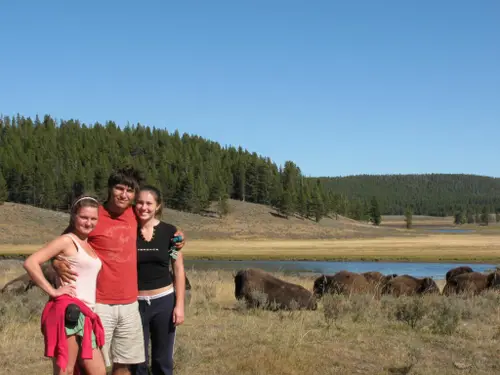
The park encompasses nearly half of the places we saw in the USA: steppes, mountains, volcanoes, waterfalls, canyons, forests, lakes, and on top of that, geysers, thermal springs, and salt mountains. Herds of bison block dozens of cars while crossing the road, deer walk within arm's reach, and so on. Yeah...)
To really feel the park and see everything, two full days are enough. (It gets dark here at 6:30 PM, so trying to see everything in one day is only possible if you're rushing, which looks ridiculous against the backdrop of such silent and beautiful nature.)
The park has a loop road that runs through all the most interesting spots. Everything happening in this huge territory can be divided into two parts: things related to the volcano and things not related to it.
First, a short backstory. Yellowstone is currently one of the largest volcanoes in the world, and definitely the largest in North America. The caldera (roughly speaking, the crater) is about 60 km in diameter, and in a worst-case scenario, if it were to erupt fully, the world would be covered in a 'volcanic winter' for several years, similar to a nuclear one. That's why this volcano is called nothing less than a Supervolcano. This is why all sorts of geysers, sulfur gas springs, and so on are located here. We are going to spend two whole days walking around this Supercrater.)))
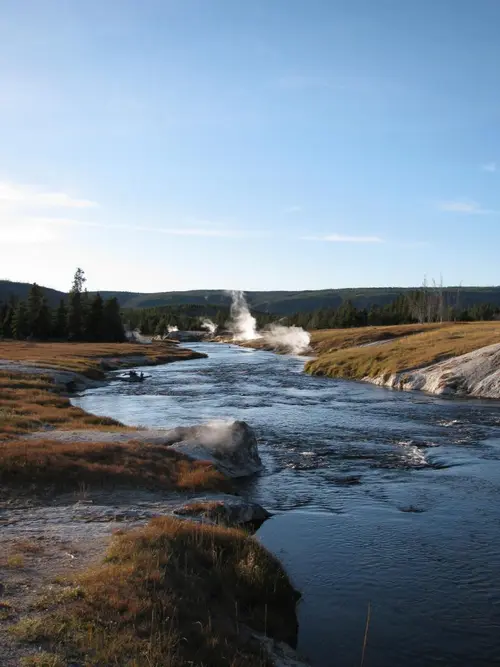
The main geysers are located in the western part of the park and by the lake in the center. There's the largest geyser in the world, the tallest, the loudest, and everything else you can imagine.
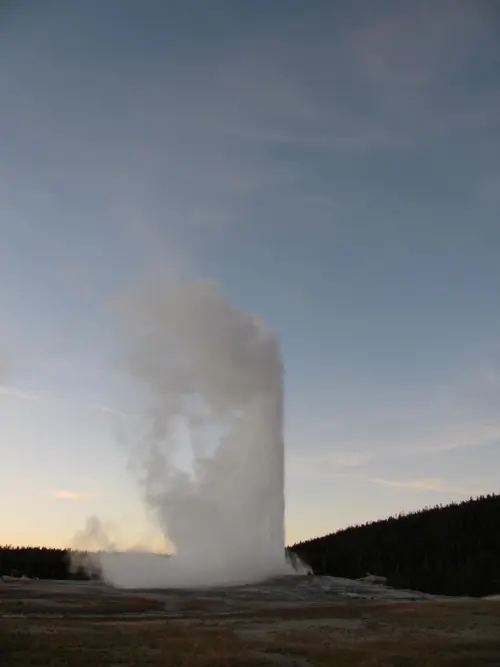
There is one that erupts at specific intervals (and visitor centers have eruption schedules, so you go like you're going to the movies, just without the tickets=)). And then there are others, like a cave where boiling hot gas bursts from under the water. You can't get close to it, but you see only smoke and hear a crazy roar. What do you think it's called? Of course, Dragon's Mouth!!!!
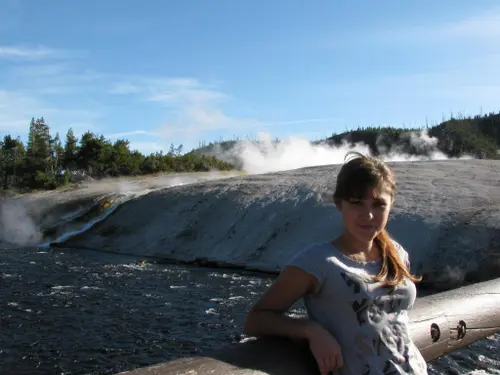
And there are big ones—a small lake that evaporates a ton of steam, like a steamboat. You walk up and step into the cloud. You can't see anything except rushing steam; it feels like you're flying, and it's very warm and humid. Suddenly, the wind blows, hitting you with icy air and a beautiful view of a deep blue lake without steam. You huddle up and run back to warm up and fly in the cloud again. It's so cool!!))
And there are tiny lakes (3 by 3 meters) with a perfectly still, transparent surface, but they are actually 15-meter-deep drops. Have you ever seen a blue puddle that you can look 15 meters down into?)) And there are dried-up ones, roaring right from under the ground like jet engines, and more, and more...))
In short, they are just awesome, and it takes at least 5 hours before you get tired of driving around them. There's a geyser like a 'Castle,' one like a volcano, mud volcanoes—in short, we're driving around and loving every minute of it=))
If you have the chance, go to the 'Morning Glory' geyser; it's probably the most beautiful one here, as it stands on a hill, surrounded by geysers, and erupts about 40 meters quite often:)