We are speeding along the highway, it's already dawn, and we still have about an hour and a half left until Niagara. The mountains have long since given way to green plains and plantations, and narrow mountain roads have been replaced by wide expressways. New York is a very technogenic state in general. There are significantly more cars and people here, cities flow seamlessly into one another, forming the largest agglomeration in the world. But there is no beauty in any of this. The sparse nature and typical towns in these parts are only diluted by one natural wonder - Niagara Falls.
Niagara Falls is one of the largest in the world and the largest in North America. Its popularity is probably enhanced by its very convenient location on the Canadian-American border and easy access for tourists. The waterfall is formed by the waters of the Niagara River, which separates the States from its maple neighbor. On both banks of the river, there are cities with the same name, Niagara Falls. Only one is assigned to New York State, and the other to the province of Ontario.
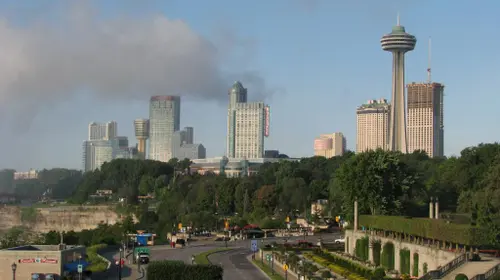
The city of Niagara Falls itself is a rather meager place. Although, in general, it doesn't differ much from other cities in the state. Wide streets, gray houses, a row of hotels on the waterfront, and an almost complete lack of greenery. There was absolutely nothing to do there, so we headed straight to the shore, guided by the sound of falling water.
Actually, even half an hour before reaching the city, you can see a huge cloud of steam rising several hundred meters into the air. At first, you might think it's exhaust from some pulp and paper mill or a burning batch of Chinese sneakers.
The spectacle itself is, of course, mesmerizing. Thousands of tons of water slowly roll toward the cliff and, taking a free fall from a height of 50 meters, crash onto the rocks and boulders below. What's impressive isn't the waterfall itself, but rather its size. The waterfall is divided into huge sections called the North and South Niagara.
Here, our first disappointment awaited us: you can only see Niagara in all its glory from the opposite Canadian shore, for which you need to obtain a separate visa. From the US side, you can only admire it from a 60-degree angle. The opposite shore and the city look much more advanced and well-maintained. A little Las Vegas, as the locals explained to us. American youth cross the border every weekend via the connecting bridge to hang out in bars and casinos, which are allowed in Canada from age 18, unlike the age of 21 in the United States.
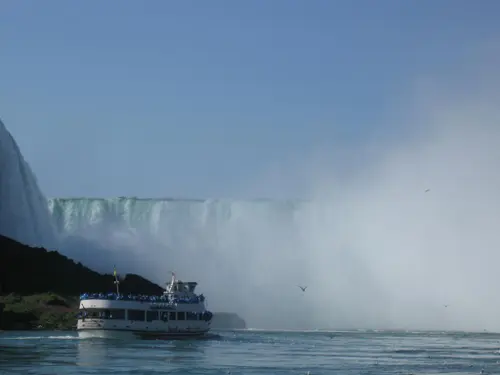
The only way to fully see the waterfall from the American side is to sail right under it on a small boat. The whole experience costs 12 dollars and, in principle, is worth the money. They give you a light blue raincoat, which doesn't really save you from the humidity at the base, because it's not for nothing that the water spray is visible from 15 miles away. At the foot of the waterfall, there is such a water storm that you simply can't see anything. I barely managed to hide my camera to save it for the rest of the trip. As a recommendation, I can advise you not to make our mistakes and wear short, quick-drying clothes and flip-flops, otherwise, you'll have to dry your feet for a long time.
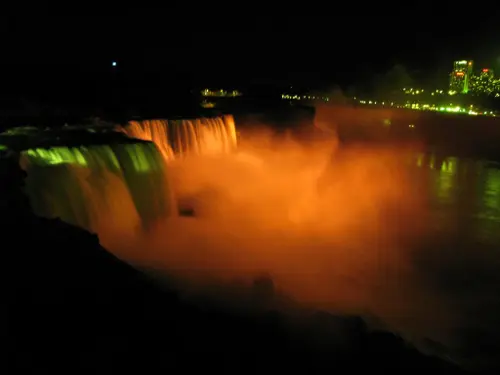
But for all its grandeur, Niagara Falls is a one-hour sight; spending an entire weekend here, in my opinion, is just silly. It is worth staying to look at the waters illuminated at night. This lighting constantly changes its hue, making Niagara turn red, then green... It's mesmerizing.
We were tired, we were fed up! We sat down in some cafe to satisfy our natural hunger and plan our further route. We didn't argue about it for long; we were at the gateway to the Midwest, so we decided to head straight to Chicago, making a stop only in Cleveland...