
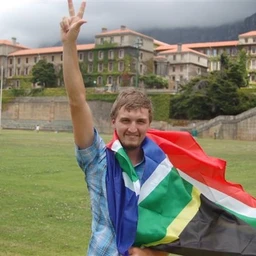
Viktor, Chelyabinsk
"I went on vacation at just the right time. In Chelyabinsk, it hit minus 20 degrees. I arrived in South Africa, and it was plus 30! The difference in weather was 50 degrees!"
Viktor
Honestly, I never thought I would have to write about this country, let alone based on my own feelings and impressions. This became possible thanks to Semyon's request.
Somehow, during that period of time called spring in Russia and the entire Northern Hemisphere, in March 2008, Semyon said to me:
— I'm thinking of going to South Africa!
— Why? — I was amazed.
— To live and work. Through an exchange program. I'll see the country, visit the Southern Hemisphere.
— The flight will be long! And what about jet lag, acclimatization, tropical diseases, all those sharks and crocodiles; crime? There is no apartheid there anymore, the white man is not treated with enough respect, — I bombarded him with questions.
— It's fine! — came the answer. — I read about the nature: the climate is subtropical, the summer is not too hot, I won't stay until their winter, as I'm going for half a year. By the way, their whole winter is more like the beginning of our autumn. And crime — just follow basic safety measures and everything will be okay. And white people live quite normally there, it's all just tall tales and rumors!
"Okay, we'll see," I thought. And for a few months, I forgot about that conversation. Imagine my surprise when, having gone to Ukraine in July, I learned that Semyon was not just thinking about going to South Africa, but was already preparing: collecting documents, certificates, and so on. He was planning it quite seriously! He found an organization (International Exchange Centre), which, by the way, is located across the street from my house, and which carries out various programs like "Work & Travel in USA, Canada, Australia".
Later, I also took a "brochure" from them about foreign internships, but I didn't read anything sensible about South Africa in the advertisement. Apparently, the country had not yet earned enough attention from our advanced youth, who prefer the "decaying" (as they said in Soviet times) West.
And a thought came to my mind: "Maybe I should go too?!"
I was worried by the complete lack of experience traveling abroad (CIS republics don't count. When I told friends that I had traveled abroad (!) to Uzbekistan, they chuckled: "Found a foreign country!" "But there's customs there!!!" was my strongest argument. "Doesn't matter! Uzbekistan is not abroad! Don't make people laugh!" they replied), while Semyon had managed to travel on a work visa to the United Kingdom, to the USA, and travel through seven countries of Western Europe and thirteen cities on a tourist package.
Returning from Ukraine, I cautiously asked if I could go to South Africa too. It's interesting after all!
— Of course! — Semyon replied readily. — I'll leave, get settled, and then I'll send you an invitation! You don't need to process many documents, you don't need to go to the embassy either. A visa, unlike America, is given easily. The main thing is to buy tickets on time: it's a different hemisphere after all, they can be expensive. And process all the documents necessary to obtain a visa, down to the last one!
In August, I left for Almaty, and Semyon began to prepare closely for the trip. Honestly, I asked him that time just like that, without much hope that I would go. But while in Kazakhstan, I thought: "Why not?" I started writing letters to friends describing the upcoming difficulties and asking questions like "is it worth it or not?" One answer stuck in my memory: "Go, of course! Africa is a completely different world, everything is different there: both nature and people!"
As a result, returning from Central Asia, I told Semyon that I was going!
He flew out in mid-September. And from October, my preparation for the trip began.
I bought tickets. In November, a letter arrived from Semyon with an invitation to visit (to obtain a visitor visa, you need to be sent an envelope from South Africa with a local postmark and an enclosed letter in English, written in free form, explaining why the inviter wants the guest to come to them). Having collected all the documents, certificates, and so on, I sent them to the embassy and waited for the visa. The passport with it arrived only after a long, agonizing wait, two weeks before my flight from Moscow.
Finally, I told my family that I was flying! From winter to summer!
Domodedovo Airport in Moscow struck me, on one hand, with its gigantic scale, and on the other, with its unusually fussy bustle. And also with indecently high prices. Among the pleasant surprises was the ability to charge a cell phone for free right in the center of the hall. I noticed an interesting feature: no matter which foreign airport the plane was flying to, announcements were made in three languages: Russian, English, and, lastly, in the language of the state to which the flight was being made. It was extremely interesting and amusing to hear the announcers making announcements in Azerbaijani and Uzbek.
Boarding the plane itself took about twenty minutes. Later, in Chelyabinsk, having counted the number of seats (there turned out to be at least five hundred), I was surprised at how quickly the flight attendants managed to seat us passengers. Boarding was not through a ramp, but through a "pocket" connected to the exit, which bears the English name "Gate". At the entrance to the plane, stewards and stewardesses kindly greeted everyone without exception with the words "Good afternoon, Sir" or "Good afternoon, Mam".
It was scary to take off, I couldn't believe that such a machine could rise into the air. Nevertheless, it did. Ahead were five hours of flight and the first, now truly foreign, airport for me.
After takeoff, I began to study the small monitor in front of me. It turned out to be a combination of satellite television, radio, a collection of music and films, as well as flight information. In total, about nine hundred different programs. I was in shock! And in delight! I learned that you can even call anywhere on the planet from the plane! True, it won't be very cheap.
Soon, drinks and dinner were served.
Throughout the flight, the route (what we were flying over at the moment) was broadcast on a large screen in the cabin: a map of Western Asia from Moscow to Dubai; the temperature outside, speed, and distance to the destination.
I transferred to the flight to South Africa the next morning.
We took off. The clock showed 8:00, December 31, 2008. In the light of the rising sun, I saw Dubai. Roads, streets, the port, the famous island washed up on the bottom of the Persian Gulf. And the Persian Gulf itself. Then the plane turned, rounded the Oman Peninsula, which separates the Persian Gulf from the Arabian Sea, and on which the Omani city of El-Khasab is located. Mountains began to be visible, bordering the Arabian Peninsula from the south, or rather, separating the most arid desert in Asia, the Rub' al Khali, from the Arabian Sea. The highest point of these mountains is 3353 meters, near the settlement of Nizwa in Oman. "Not small mountains!" I thought.
The plane then moved across the Arabian Sea to the Horn of Africa (as the Somali Peninsula is sometimes called), turned south, then crossed the equator and flew along the coast to the capital of Tanzania, Dar es Salaam, from where it turned south-southwest and was already flying over the African continent. It flew over Mozambique, Zimbabwe. The Republic of South Africa began: Pretoria, Johannesburg, Bloemfontein, Kimberley.
Finally, Cape Town appeared. The flight took almost ten hours!!! When I stepped onto the ground — stepped out into the open air, I immediately understood: I had arrived in summer! A warm, gentle breeze blew over us. And the presence of the ocean was felt in the air.
We began to go through customs control. A black border guard studied my passport as if he had never seen a Russian before. He even called his boss to look. Then he asked who I had arrived to visit (the visa was a visitor visa after all), stamped me, and wished me a pleasant time in South Africa.
And here I am — finally in the southernmost country of Africa, the former stronghold of colonialism and apartheid!
I went out into the waiting hall, and Semyon was meeting me there. I was overjoyed!
We arrived at his place. I had just unpacked my things and taken a shower, and the sun was already setting. And New Year's Eve was approaching!!!
We set off for the beach, on the way Semyon's friends picked us up, and we went to Camps Bay as a group of five. I really wanted to get into the water and swim as soon as possible, to which the guys warned: "The water is cool!".
However, what did it matter if, firstly, it was the ocean, secondly, the Southern Hemisphere, thirdly, December 31st, and fourthly, I had come from the Urals! The water temperature of plus fifteen did not scare me at all!
We sat in a circle, spreading a blanket on the grass and unpacking bags of food and champagne. Everyone eagerly fell upon the food and drinks: we started celebrating the holiday! (in the Urals, by the way, it had already arrived by that time. It was ten o'clock for us, and South Africa is three hours behind Chelyabinsk). By midnight, we decided to go to the Waterfront to watch the fireworks.
We enjoyed the views of the colorful flashes. We shouted with the crowd, congratulating each other. We only got home at three in the morning (six o'clock Chelyabinsk time)!
On January 1st, Semyon proposed a plan of what we could manage to do while I was here. Everything suited me, I agreed! I won't describe all our travels in the same detail as in his book, so as not to repeat myself. I'd rather focus on what I liked most, and what I remember my fairy-tale vacation for — the best of all I've ever had in my life!
First, I want to note the features of the Republic of South Africa that I immediately noticed: firstly, left-hand traffic. Secondly, that the numbering of floors, as in the British Isles, starts from the second, which is called the first floor, and the first (in our understanding) floor is called the ground floor. In addition (these are already household features), sockets in houses have three round holes, sinks often don't have mixers, and cold and hot taps are on opposite sides of the sink. Having shown me around the district, Semyon instructed: "It's better to buy groceries in large department stores — they are cheaper there, and in small shops everything is a third more expensive," — disconcerting me a bit with this. — "The food here is delicious everywhere! As for clothes: it's better to buy in stores, not at markets!"
On the way to Clifton and Camps Bay beaches, passing Sea Point and the no less luxurious Bantry Bay, the road snakes along the coast past villas and mansions of one, two, and three stories. It's hard for me to estimate the cost of the modest charm of the South African bourgeoisie... The only thing that comes to mind are the words of the King from the film "An Ordinary Miracle": "The house is so nicely arranged... I would just take it and take it away!" And so that no one would have the desire to take it away or just climb onto someone else's private property, all more or less decent private buildings (as well as railway stations and government institutions) have fences with wire stretched over them with a modest inscription "Warning (or Beware)! Electrified Fencing", further, starting with the word "Gewaar" — apparently the same thing in Afrikaans, even further, starting with the word "Insozi" — in one of the African languages, possibly Xhosa.
Streets in the center have either English or Dutch names, although English ones still predominate: Long Street, Loop Street, Napier Street, De Waterkant Road, Bree Street, St George’s Street (one more thing I never fully understood: how Street, Road, Lane, Drive differ from each other — however, maybe even the locals don't understand this, they are just used to the names).
I was certainly impressed by my two-week trip. Especially since it was very eventful. The strongest and most joyful memories were left by the Cape Town mountains. It's some kind of miracle, of course. And the ocean!!! It's fantastic! The waves in Cape Town, as I verified, are much more powerful than any sea waves: they can knock you off your feet.
Sunsets were grandiose and not Ural-fast. The surprisingly clean air of the Cape Province left completely unique visual sensations — as if the landscape, including the shore, villas, mountains, the ocean, and people — all this was carefully drawn in a painting and captured in my memories just as brightly, in colors.
In the center, along Long Street, the first witnesses of British colonialism lined up — buildings of the nineteenth century. With all our current dislike for the Anglo-Saxon mentality (including their manner of acting assertively in everything, even, frankly speaking, impudently, especially with those who are weaker and less developed), I must note that without South Africa becoming part of the British Empire, it could have remained on the outskirts of world civilization. And so — as soon as Holland ended up under French control during the Napoleonic Wars (it was even called the Batavian Republic for a time), in Britain, France's main opponent at the time, they decided: "Why does the Cape Colony, such a wonderful outpost in the south of Africa, remain ownerless (since the seventeenth century Cape Town, then Cape Stad, belonged to Holland)? This is a mess!"
And from 1804, Cape Town and the Cape Colony (or rather, the extreme southwest of the old South African Cape Province) became British after the dispatch of the British Royal Navy. This was followed by wars with the Boers, Zulus, Xhosa, the big trek (the migration of the Boers to the northeast of present-day South Africa), then another series of wars, the crown of which was the famous Anglo-Boer War of 1899-1902, colorfully described, from the point of view of the Boers, in Louis Boussenard's novel "Captain Off-the-Wall".
On the third day of my stay in the city, in the center, we accidentally stumbled upon a large-scale festive performance — a procession. Its participants were dressed colorfully, with a predominance of pink. They carried flags, sang, and danced — a whole theatrical performance appeared before our eyes. A thought even came to my mind that our person, of course, knows how to work, but how to relax — not always.
Honestly, before the trip, of all the sights of the southernmost city in Africa, I only knew about Table Mountain.
In two weeks, I almost got used to left-hand traffic and the need to look first to the right, then to the left, and to the manner of Cape Town drivers to "drive with the breeze". When I was flying home, I read in the newspaper that one driver was fined for driving at a speed of two hundred (!) kilometers per hour.
When you get to know a country, it's always good for a complete picture to see it from different sides — natural, that is, geographical, scientific, cultural, and so on. The University of Cape Town (UCT) turned out to be a combination of the natural, scientific, and cultural sides of South African life.
The road to the main building of the university, from the minibus taxi stop, was beautiful. When we reached the very first buildings, we were struck by the silence.
The first building, near which we took a photo, was the South African College of Music. Sounds of a piano drifted from the windows, and I remembered how I myself once (including on weekends) practiced this art.
Then we climbed up the path, climbed to the building called the Brenner Building, with a huge stand schematically depicting the University buildings (Campus Guide). The university on the diagram struck me with its scale. Being on the university grounds had a calming effect. As if all the world's problems are somewhere very far from this place. Or in a completely different world.
Climbing up the paved paths to the Upper Colleges, we passed through a tunnel and found ourselves on a lawn that could easily accommodate three football fields. The lawn was neatly watered by rotating sprinklers, so standing in one place, you could get under the stream. The university (or rather, its main building, facing the field) is covered in ivy.
Climbing to the building, we took a photo at the monument to Cecil Rhodes (in whose honor the colony of Rhodesia was named, on the site of which there are now three states — Zambia, Zimbabwe, and Malawi). On the monument, under the inscription about the years of birth and death, an excerpt from Kipling's poem was carved: "I dream my dream By rock and heath and pine Of empire to the northward Ay one land From Lion’s Head to line". "Well, well," I thought, "despite all the criticism of colonialism and apartheid, the monument was still preserved." This monument, along with many others, is a legacy of those times (glorious times) when the British Empire ruled a quarter of humanity and tried to leave its customs everywhere (or almost everywhere). It is amazing how such a territorially small country managed to subjugate not just huge spaces (like Russia or Spain in their turn), but also states, even empires, and rule them, even introducing its own language there.
Since the main building was very large, we decided to go into the left wing with the sign Fuller Hall. The watchman, in response to our request to "come in and take a few pictures", let us in quite kindly.
The inner courtyard struck me with even more tranquility than even the garden in the Lower College, from where we had come. We walked through the campus, which, like in England, consisted of separate entrances numbered alphabetically. We went upstairs, looked at how "ordinary South African university professors" live. Then we went into classrooms, looked at the conditions in which professors work. In the auditoriums, I was struck not even by the antiquity (fireplaces, nineteenth-century paintings on the walls, oak tables and doors), but by a huge, one-and-a-half-meter diagonal liquid crystal monitor in one of the halls.
Then we went up to other buildings. We even met several black students who really didn't even look like the merchants and beggars who are so numerous near the station in the center. After all, education is a great thing: everyone who receives it joins not only science but also culture.
We returned with the mood that one has after a very good concert or play, when you feel that life is short, and art (in this case, the university) is eternal. I won't hide it, I wouldn't have refused to go to Cape Town again just to see the university one more time.
I really liked how we celebrated the "summer" New Year and "Russian" Christmas in the company of Semyon's friends. The wonderful, almost fairy-tale "Capital Pretoria", which conquered us with its beauty, left indelible impressions. And all that journey of ours.
I remember the contrast of everything, in the entire South African culture. Both in people, and in architecture, and in music, in food and traditions. Often I thought: "This is truly abroad: everything is not like ours!"


