Everything is happening very fast for us. Time is the same, but it doesn't want to reckon with anyone. We only managed to count to three: one-July, two-August, three-September... It's like opening a cherished door, not having time to see what's behind it, and slamming it shut immediately.
Our vessel of life is bubbling, exploding, spraying juice, and overflowing. Inside, everything is turning over, being remade, twisting, and flying apart. But on the outside, it seems like nothing, a calm. This is only for us, what is happening inside. Because no one else can understand it.
Having visited different corners of the globe, unfortunately, I won't be able to write a single line about many of them because I won't remember anything. Sooner or later, one has to say goodbye to memories. I write only because I don't want to get lost or confused later. Not to photograph or not to write down means to lose the connection with the past. I cling to my memories with claws, tightly, dead-set, so that they don't give me peace later.
Circumstances were such that initially we were supposed to go to a more northern city, Providence, near Boston. We dreamed about it all year, made plans, looked for places, scheduled evenings and weekends. We truly fell in love with it. But three days before departure, we were redirected to Durham. It was inferior to Boston and Providence in everything - there were no large famous cities, skyscrapers, national parks, or amusement parks nearby, and besides, it is much smaller and more boring. We were going there without knowing what to expect, but there was no choice anymore. So, having spent half of June, July, and August here, we thought all this time that we were living in the most boring and unknown city in the world. No one would dare argue with the fact that it is boring. But then, sitting one evening in front of the TV in Sarasota, we were extremely lucky in finding a movie - painfully familiar landscapes of the Lucky Strike tobacco factory and the Durham baseball field flashed on the screen.
Once upon a time, our city's baseball team secured victory so often that this story was taken as the script for a movie starring Susan Sarandon. It was considered the best sports film adaptation. Then, seeing this movie, we almost choked - living here for three months and not even knowing that Durham is so famous. But in general, it would hardly have changed anything.
I am often asked a question (quite reasonable, though not accurate), what I like or dislike most about America. Like a big and good book, you can't say that you just like it or dislike it; that's not enough. America is a glorious country, with its own flaws and vices. In my stories, I can boldly speak out about Russia or America without mincing words. And what is the point of dodging and avoiding what everyone already knows?
I can imagine the sincere shock of an American who was not lucky enough to come to Russia without preparatory courses or at least stories about the Russian mentality. What do they even know about Russians? Associations are roughly like this - "vodka", "cold". That's what the average American thinks, as shown by the frequent surprise of our foreign friends when we told them about Russia. It's funny and brings to mind thoughts of ignorance.
We don't live behind such an iron curtain. Russians know everything about the American way of life; they read articles about them, create communities, don't miss a single American movie, buy notebooks, pads, keychains, and posters with the Statue of Liberty and skyscrapers, t-shirts with the American flag, and borrow more and more words from English, while Americans don't even know that they are a role model, and the only thing they remember about Russia is still that it's cold there. And they only borrowed "babushka" and "sputnik". You'll be lucky if you talk to an American and they don't ask you if you still live in the USSR.
In this country, everyone is for themselves. People make friends more easily and break up more easily, let their children go to study in other cities and countries, and they return very rarely; they don't have home gatherings with grandmothers and grandfathers with squash caviar and homemade dumplings as common as we do. It's unlikely that any of them will miss, worry, and torment themselves with memories if someone's former love interest decided to leave them. Despite this, you can often see photos with friends that beam with joy and love for each other. Everyone we knew didn't have real friends. In their opinion, no one can rely on another person completely.
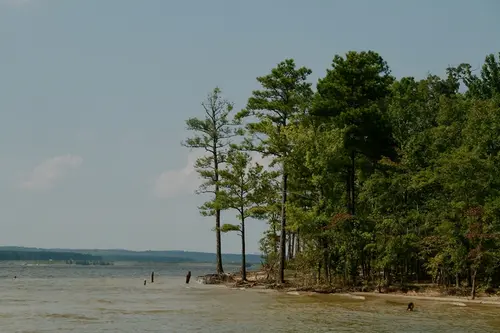
Almost on the last weekend, we head out to a local lake. We had been planning to go there for a long time, but something always didn't work out as it should. Almost everyone here has cars. Only simple workers like us ride buses. Finally, our friends from the restaurant, Luis, Ben, and Victor, decide to take us out into nature.
For Russians, a picnic means a lot of food. There will definitely be a cucumber and tomato salad, greens and onions, sprats with black bread, and snacks to the taste of the picnic organizer. It's kind of an excuse to eat. Here we had a gentleman's set: chips, beer, and shashlik. Since Victor is a chef, the shashlik is soft and fragrant, soaked in lime juice and with some Mexican seasoning, without vinegar. Victor threw us a little party.
And then the sun began to set. It was very cloudy, but one ray kept trying to penetrate through a crevice in a stone sticking out of the lake.
We lay on the shore almost until sunset and left when the ground stopped holding heat.
Every time I talk about the personality of some American. This time I choose Luis, one of the Venezuelan guys working in our restaurant. He is a volcano with bubbling energy; after talking to him for ten minutes, you will get complete emotional satisfaction.
Like volcano-people, his laughter is loud, growing, similar to the sound of a ball rolling right at you. Luis loves to play childishly and joke around. Once we made snowballs out of shaved ice and threw them right in the restaurant. I threw a snowball down his collar with the words "Welcome to Russia", and it seems that in his subconscious, the association "cold" was forever fixed to the word "Russia".
Luis's eyes always gave him away. I wouldn't be able to single out anything special in the color itself, but because of the long eyelashes, they looked pleading and were always a little moist, as if from tears. Because of this, it always seemed that he was only cheerful here, with us.
Sometimes you leave your order notebook on the table unattended, and Luis is right there - look for some drawn bird or smiley face on the pages later.
If he served a table, people at it sooner or later burst into laughter, and girls, women, and children were never left without attention. Attention was what made him a good conversationalist and listener.
On his thigh, he sports a tattoo "made in venezuela", as if reminding of his childish side of character, and on his arm, the numbers of the Bible commandments are tattooed. He said that it says there that the main thing is what a person has inside, not what they are on the outside. When I heard this for the first time, I was slightly surprised by his seriousness. But then I got used to it - he often went into himself.
Luis was one of our best American friends after Victor. Everyone said goodbye to us: from the restaurant owners to its cleaners. Everyone except him. That sometimes happens in America.
We visit the most famous private research university - Duke University. It is clear that the residents of Durham are proud of such a prestigious institution. Even if they don't study there (and tuition costs 40 thousand dollars a year), you can buy t-shirts, mugs, magnets, and other trifles with Duke symbols in almost any supermarket. The university is on the list of the best universities in the USA and is the largest research university in the country. Those receiving education are mainly wealthy people aged 30-40 from all over the world.
Buildings of different faculties are located next to each other; it is a whole united student complex. We even managed to enter some of them. What you see in the photo is the building of the business and political science university, and students study here. It seems we entered there around 3 pm, the doors were open, computers and televisions were working, but there was not a soul in the building. We walked around all the offices, looked into the conference hall and classrooms for students, but there was dead silence.
On the wall hangs a modest map where the countries of visiting students are marked with pins, and stamps and photos are attached below. A very voluminous collage...
I wondered many times, what is the motivation of such students? After all, some, although a very small number of them, study at Duke absolutely for free (of course, the smartest or those with big connections). What must be the aesthetic pleasure of being here, how pleasant it must be to sit on the lawn in the garden of one of the best institutes in the world, importantly carry your pass from Duke in your business card holder, pronounce the name of your educational institution with pride in conversation, and then tell everyone about classes with slight arrogance. It's worth it..
During this time, I could never say that I want to go home. But something tells me that if someone says that I can stay there forever, I will immediately run back. This is alien, this is not for me, for others.
We always try to cork the summer, to save it. Grandmothers and mothers make jam and juices from fresh berries, those keen on photography gladly glue sea photos into albums. I even have a glass ball with sand and shells inside. I look into it, pressing my nose to the glass, and its sphere for a moment appears as the sky and the ocean. It's all a deception, you have to deceive yourself all the time until summer comes. There, like in childhood, everything is real.
This summer is real, I realized this as soon as I met it.
Reality is completely different. And soon we will have to return to it. I remembered it like this:
Most likely, it will start raining during the day and pedestrians will take out their best waterproof shoes and umbrellas, will grumble about the weather, and something will go wrong for them. Because when you grumble at someone for no reason, everything goes wrong. And people will stand at bus stops with wet hair, with mascara smeared by water, and in slippery shoes, hiding under canopies and smiling at each other out of mutual sympathy. Cats and dogs will brush raindrops off their whiskers, put their muzzles on their paws, and sigh. Somewhere new owners are waiting for them. People will also get sad. Someone on the porch will look at the clock, nervously or tensely, as if it could stop the rain. There will be a smell of cigarette smoke and dampness. Shoe soles and noses will squelch. The rain will intensify and people will press themselves tighter against the cold walls. Passengers caught by surprise will run from the buses, clutching colorful umbrellas. They will look into shop windows and, out of boredom, will buy something in the store that they don't need. And everyone in an instant will become lazier, slower, more clumsy, as if the film got stuck and the signal is constantly interrupted. And everyone will yawn. So long and drawn out, as if during yawning they fall into a short sleep and manage to see dreams.