A box. There is nothing on it, the lid gives way easily. These are puzzles of strange shapes, zigzag, voluminous. In each one, I see fragments of my life, but they are so hard to recognize. If you turn them in your hands, you won't see two that are the same. This time, I keep coming across pieces from my summer. Right now, they take up the most space in my memory; someday they will take up less, so I must manage to assemble them now. I never know in advance what is drawn on the lid of this box...
Cities, like people, it is impossible to know everything about them; they have their own secrets and one can fall in love with them.
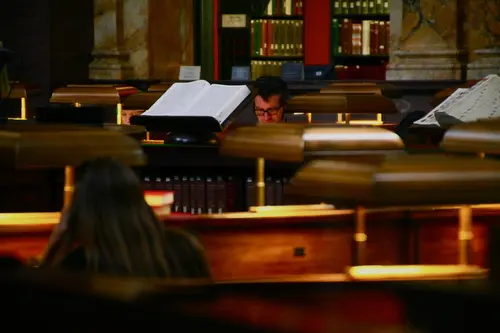
Washington, United States of America. Libraries remind me of temples. You open the door to eternity, you become a witness to the existence of the world mind, you feel the inner fullness of everything, as if you have been opened up, reminded of the spirit of antiquity with all its dust, wisdom, and eternity. Here, people lose the gift of speech. People themselves created these two temples—for books and for God—and they themselves became guests here—timid, silent, as if they are afraid of dropping or touching something all the time. They guard a sleeper in the deep sleep of an infant who has just been calmed. And everyone walks on tiptoe and whispers, they don't shuffle, and only cough and rustle pages.
Library of Congress. Amazing proportionality of the Renaissance. They printed me a real pass with a photo. The hall is forged from an ingot of gold, and the dome is an openwork napkin with gilded fringe. It is supported by five marble arches arranged in a semicircle, and in each of them are niches, similar to each other like two drops of water. In the middle of each, there are small platforms from which famous personalities watch the crowds, such as Francis Bacon, Plato, Newton, Shakespeare, Beethoven, Columbus, and Michelangelo. They implant faith in you, majestically silent, embodying all the world's riches that man has ever created with the help of reason and inspiration.
George Washington Memorial. An arrow aimed at the sky. Its exact copy, piercing the earth, is reflected in the pool. It seems that these two arrows are about to be released, and something terrible will break out. But this monument is the grace of Washington, his starting point.
Many eyes, lips, hands are scattered, but never faces. Faces are never stored in their entirety. Roads, smells, noises, even winds are remembered, but for some reason, faces disappear first. They fall, as if into an abyss, into the distant caves of memory. There is so much to remember in a face—the gaze, the color of the blush, the small shadows in the corners of the lips, the outlines of the eyebrows, the irregularities of the cheekbones. Moreover, it has hundreds of different types. How we look at ourselves, at people, how we sleep, how we laugh and frown. In a person, only the face changes so dramatically. And we don't even remember the color of the eyes. Small details are scattered across the consciousness in a soulless disorder, and there they mix with other faces, and that's it, they can't be retrieved afterward. The drawing will never appear again. Only pollen will remain, which you are afraid to touch. After all, besides it—nothing. Unhappy particles. Everything we have is pieces of a mosaic, and we always absolutely need to assemble it to the end...
It seems my bed has spent years imprisoned in a solitary cell. Ribs are sticking out of the mattress everywhere, and it looks so sickly that I covered it with ten sheets, but even that didn't help. Imagine having to hug a skeleton all night long. True, when I return from work after one in the morning, fatigue smooths everything out, and the bed seems quite tolerable. Sometimes I really think it's better to sleep on the ground than on my dystrophic mattress.
When I have a break in the saving hour between jobs, I go to the embankment, spread out two crispy bags labeled Dunkin' Donuts on the sand. At the same time, I have to sit on one quickly to hold the second one down. I put a cloth backpack and a white boy's polo shirt under my head. So, I dive into sleep for the most solid forty minutes to the sound of the ocean and the barking language of the Americans. The sand can be adjusted to the shape of the body, and when I get up, my sleeping silhouette is clearly outlined on it. Legs curled up, because I was lying on my side, a dent from the backpack, and three dots from the fingers that accidentally hit the sand when I was mechanically looking for the alarm clock next to me, not under the pillow. The alarm clock rings somewhere under my neck, and I fold the two bags into neat squares and take them to the trash can, which says "leave only your footsteps," which doesn't literally mean "don't litter," but literally means "leave only your footsteps."
I walk barefoot on the boardwalk, swaying from sleep in the sun, shaking sand off my heels, but it refuses to come off. I peer into people's faces. They accurately divide the wooden embankment into two parts, one crowd goes in one direction, the other in the opposite, like a two-way traffic lane. It turns out that I look at them, but they don't look at me, because everyone is engrossed in conversation. Almost no one walks alone, like me.
My first job is Dunkin' Donuts for lovers of simple pleasures made of frozen dough. These are donuts with tops like slippery jack mushrooms that have just crawled out of wet soil. A greasy trace melts from them on the pink paper as soon as it lies on it for a minute. The closer to night, the more greasy traces remain on their bed, because the donuts gradually fulfill their purpose—they are laid out in boxes and prepared for a journey into stomachs stretched by carbohydrates.
It's funny that people buy by the dozen the ones I have a special irony for, like those in powdered sugar. It doesn't fall off, which is very strange. Or those whose lemon filling looks like the liquid I drip onto a microfiber sponge when I wash dishes. Sometimes impatient people stuff these treats into themselves in the time it takes you to count out four dollars in change, and as a memory, they leave sticky powdered sugar and a soiled receipt on the table.
My Hungarian friend Dominika and I work in the evenings. Which means with one hand we put donuts into boxes, and with the other, we scoop Baskin Robbins ice cream, the freezer of which is adjacent to the donut shelf.
For a whole week, Dominika and I couldn't move our arms because the process of creating one scoop of ice cream resembled carving a needle in a glacier with bare hands; we had to lean our entire weight on the miserable round spoon. Once I even broke it on the ice cream, a piece flew off it. All because this cannot be called ice cream. Dominika and I were seized by a slight hysteria: she laughed in three bursts, bending her injured wrist, bandaged, wrapped in a special elastic bandage, for which she had to give up quite a few tips. Then she would add, "How do you think Anastasia, will my parents recognize me in a wheel chair?" And then she looks from under her brows, puffs out her cheeks and lips, and says, "I'm gonna kill myself, Anastasia." She does it so seriously that I laugh every time.
Dominika is very round, as if if you pushed her, she would roll. She is never in a hurry to go anywhere. I have never seen her with a worried look. And she talks as if she is throwing balls. She rounds every word with her smooth Hungarian accent. The balls fall and scatter into hundreds of bells of her laughter.
Once she fell in love with a guy who engraved bracelets on the beach. According to her plan, he was never supposed to know how much she liked him because she didn't believe in herself. She met him the way we met all the people in Ocean City—he came to us to buy coffee and stayed to talk. They exchanged phone numbers, and from that moment on, Dominika wouldn't stop talking about him. She didn't become absent-minded, didn't drop coffee, didn't slip on ice cubes from the ice machine, didn't mix up sandwiches, and counted change correctly. I looked for a catch, wondering how one could be so in love and so efficient. There was some kind of even, compass-drawn, ideal striving for eternal cleanliness and order in her; she never neglected her duties under any circumstances. But she was undoubtedly in love.
Dominika really wanted me to look at him, and one day I specifically walked to the bracelet department on the beach. I pretended to look at the engravings, but I was peeking into a small window. The guy was talking on the phone. I involuntarily listened, as I heard Russian speech, which surprised me very much. Then he noticed that I was looking at him, smiled, covered the mouthpiece with his hand, stood up, and asked, "How can I help you?" The guy was Kazakh, tall and slender. I remembered that he was agile, energetic, with refined movements, like a dancer. The complete opposite of Dominika in everything. Apparently, except for the fact that they often smile. I imagined him next to Dominika and was surprised by this thought. It would have been a funny couple.
I didn't give myself away, said, "I'm just looking, thanks," smiled at him with the most rehearsed American smile, lowering the lines of my lips as soon as my gaze slid off his face, and pretended to be interested in engravings with my name. The guy smiled back with dimples on his cheeks, took his palm off the mouthpiece, and began to talk a little louder. He was laughing at the girl on the other end of the line, and she was reciprocating. Realizing what was going on, I stopped pretending to look at the straps and walked away, a little confused by the fact that he speaks Russian and by how sorry I felt for Dominika.
Then he started coming to our donut shop. His smile acted on my friend like heat. Her childish cheeks puffed out and flushed even more, her eyes became huge saucers overflowing with stars to the brim, and her laughter rang like crystal. When he left, Dominika would cover her face with her hands and mutter something incoherent, and the redness wouldn't want to slide off her hands and cheeks.
I couldn't bring myself to admit to her what I had heard back then. She talked about him so willingly. When it was her birthday, he engraved a personal bracelet for her with notes and a treble clef. For the rest of the summer, she wore it without taking it off, twirled it on her wrist, and examined it as if she were trying to decipher a hidden message there. I watched all this from under my brows so that I wouldn't have to talk about him and accidentally let it slip.
But one day he told her himself. I began to hear the ringing of crystal in her laughter less often, everything in her somehow settled, sank, as if lush dough had deflated when it was pricked with a fork. She said that in the last five years, only he had liked her so much, all the others were not the right ones, not like that, different. And Dominika was just a good acquaintance to him, and he didn't see how much she liked him because men never see anything right in front of them.
He perceived the crystal in her laughter as a very ordinary phenomenon, attributed the stars in her eyes to childish spontaneity, and explained the blush to himself by the fact that it was caused by the heat or her excess weight. But I saw how sincerely and truly she liked him, and, looking at this from the outside, my heart was breaking with sympathy.
Then, when he was leaving, he came to our Donut shop to say goodbye to her. Then she turned pale, put the ice cream on the floor, closed the freezer door tightly with both hands, wiped her hands on her apron, and went to him. He smiled at her and danced in place. They left Dunkin' Donuts and didn't appear for a long time.
She ran in in tears, and I had to fold my arms into an O shape to hug round Dominika. I felt awkward asking what had happened there, and I was silent and just watched in amazement as the crystal laughter returned to her, as the stars in her eyes shone again, and as the blush touched her cheeks so strongly.
Love in a locker, forever. Under a glass dome, like a museum piece, without dust, dirt, and judgment. She will remember these moments at any moment because they are unattainable. One can still continue to dream about them, although they may not have a continuation. In new people, she will now look for her bracelet engraver. Once, he engraved that very encrypted message in her memory. And she will look for people similar to him at least remotely, and subconsciously she will fall in love with them. And all because she forever remembered his face in all its expressions. It will always be somewhere behind her heart, so when recognizing his features in other people, flashes, bursts, radiance, catastrophes will erupt in her memory...
This is the superlative degree of love. To be forced to give it up at its peak. While it hasn't yet overgrown with algae, hasn't been covered in mold. It will be eternal because it never had a sad ending.