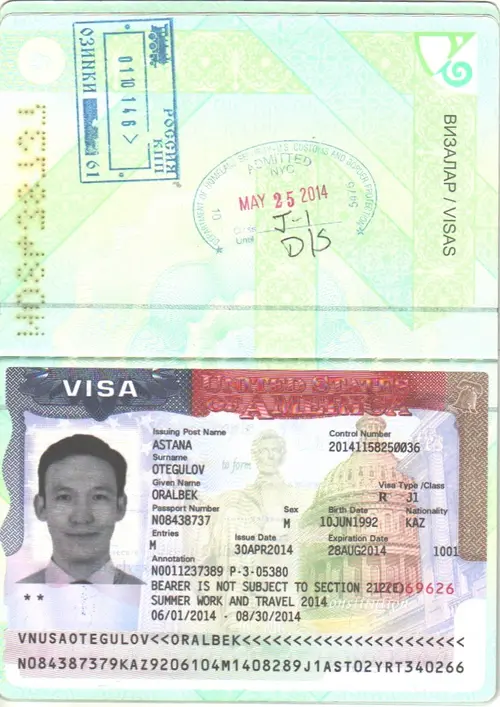
April 29, 2014. Around 11 a.m. Astana. American Consulate. The dialogue between Kazakhs and Americans continues. They seem to be getting along well. All the students are coming out happy. But how will I get out of here...? An interesting question...
A few minutes ago, I was afraid of mishearing a question and giving a wrong answer due to my hearing impairment, and now I am worried about the lie I told just a few seconds ago. According to the third rule of passing a visa interview that was drilled into our heads: "You must never lie to the consul." But I had to break this rule. I hope the consul doesn't notice...
The guy interviewing me also wears glasses, just like me. "Maybe he'll let a fellow glasses-wearer pass without failing him," I thought. Then I thought that one day I might be in such a position myself. I have always liked the diplomatic service. To do that, first of all, I had to learn the language. With this goal in mind, without finishing school, right after the 9th grade, I went to college to start learning English from scratch. My decision was like a bolt from the blue for many people. Most of them, who expected me to become a history teacher, first took it as a joke, and then couldn't understand my choice. "A kid who doesn't know a thing about English wants to become an English teacher? How ridiculous. He'll be back in a month or two, unable to study..." — that's what many people thought about me back then. Only I knew the secret behind this. After 7 years, I am revealing to you a secret that no one knew until now. "If I can, I'll be a diplomat; if not, I'll be a teacher or a translator. In any case, a person who knows a language won't be lost!" — with this goal, I chose English and became convinced of the correctness of this path.
Another thing that increased my interest in diplomacy and politics was Kassym-Jomart Tokayev's work titled "Belasu". In 2011, while working as a mentor in a children's summer camp, I bought this book with my first salary. It's a very wonderful book, but it's hard to believe that he wrote it himself. Maybe he did. After all, he is the son of a famous writer. In that book, Kassym-Jomart writes that he once worked at the Soviet embassy in Singapore. He also dealt with visa issues, just like the American standing in front of me now. One day, he jokingly said something in Russian to a person who came for a visa (if I remember correctly, it must have been an Australian citizen). Apparently, he thought Tokayev was a local Singaporean, and he was shocked when he spoke Russian. Looking at the American consul behind the thick glass, I remembered this incident. "I wonder if this person will joke with me about something...? Americans are fond of jokes..." While I was thinking about all this, the interviewer managed to ask his next question. As luck would have it, this question turned out to be a continuation of the one I had lied about just a few seconds ago:
-
Can you cook «Beshbarmak»?
-
Yes, of course! – I didn't even notice how the answer automatically slipped out of my mouth. Oh, mon Dieu! Now what if he asks how «Beshbarmak» is made? How should I know how it's made? Something I've never cooked in my life. Okay, I'll just say they cook it by adding meat, dough, and potatoes, but what will I answer if he asks about the process? How should I know what to put first, what to put second...? This lie is enough! I can't lie to the consul anymore. This is the second time I've lied. "He's definitely going to fail me. That's it, say goodbye to your dream! – No, wait, stop! Nothing is certain yet!" — I was struggling with my own thoughts. The consul didn't even look at my face. He glanced at me as soon as I arrived, then looked once when I asked "In America?" back to him, and that was it. He asked all his questions while looking down and flipping through his papers. Sometimes he looks at the computer, sometimes at his papers. He doesn't look at me standing in front of him. Let him not look! Let him not see my face, which has turned red from lying! Then, while flipping through my student record book lying in front of him, he asked his next question:
-
Are you good student? - I didn't hear the question:
-
Sorry?
-
Are you good student? - I still couldn't hear:
-
I’m sorry, but I didn’t catch you...
-
A R E Y O U G O O D S T U D E N T? – he said, looking at me angrily and raising his voice. Only then did I hear:
-
Ah, yes! – I was flustered. For me, who was worried that he might ask about Beshbarmak, this question seemed to put my mind at ease, but it didn't last long. I became anxious again, hoping he wouldn't see the only grade 'three' I had in German among my straight 'A's and 'B's in my record book. Because since he was looking down, he might not have noticed the first two lies I told, but if he sees the only 'three' in German in the student record book in his hand, it will be clear that I am lying. A consul asked the same question to an acquaintance of mine whose record book was full of 'threes'. He also answered "Yes". The consul, who was angry at this, opened the record book of my acquaintance who lied, pointed at it, and scolded him well, pointing out that he was lying by saying "Are you a good student?". After that, my acquaintance got a "refusal". If he notices my only 'three', there is no guarantee he won't do the same to me. However, one should not lose hope in vain. The consul flipped through my record book in a hurry and closed it... He took the pamphlet lying in front of him and held it towards me:
-
Did you read this pamphlet?
-
Yes, I did.
-
Do you know your rights?
-
Yes, I do.
The consul put the pamphlet back on the table, put a pink-colored sheet of paper inside my passport, and slid the document towards me:
-
You need new photo?
-
Sorry?
-
You need new photo, – I didn't understand anything! Rule number five: if they return your passport, consider it a "refusal" immediately. I slowly reached out and took the document in my hand. So, he must have sensed that I lied to him...? Otherwise, why would he give a "refusal"? I answered all his questions, didn't I...? Rule number six: "If you get a 'refusal' from the consul, take your document silently and leave. You cannot ask the consul any questions or raise a fuss there. The consul makes an independent decision. He decides for himself who to give a visa to and who not to. No one can say anything about his decision." Holding the document in my hand, I took a step back like a robot and turned to the left. When I turned, the blonde lady who had been monitoring the silence and order in the hall was coming towards me, speaking Russian rapidly. I couldn't understand what she was saying. At this moment, my perception-response reflexes had shut down. I could only see her lips moving and addressing me. She was probably asking me what happened.
-
You need new photo, - I said. By the time I said this, she had already managed to take the document in my hand and see the pink paper inside.
-
Go, take a photo again!
-
A..?
-
Go take a photo and bring it back here! You passed, don't worry, - this lady was Ms. Zhuldyz Yelyubayeva. I am seeing her for the first time. I didn't think she would be young and this beautiful...
I turned back and kept going without looking at anything. As I was leaving, one of the people sitting inside seemed to say something to me, but I couldn't understand anything. All I could think about was getting to the post quickly, taking my bag, my mobile phone inside the bag, and calling my coordinator in Aktobe to ask for advice. I rushed outside, speeding up without looking back. Dariga Rabayeva, a translator who is a sophomore at our university, also came out with me. Even though we had been seeing each other for two years, she had never spoken a word to me, but this time she was bombarding me with questions from behind. As I was answering quickly and briefly, her questions started to repeat. "Is this girl sane? Or is she mocking me?" — I thought, and the poor thing doesn't understand Kazakh at all. Oh, you poor thing! Another mankurt who doesn't understand Kazakh! I stopped answering her questions. Not getting answers to her questions, she started asking them in English. By the time I answered 2-3 questions in English, we had reached the post. I took my bag from the guard and left without looking back. As soon as I took my phone, I called my coordinator:
-
Hello, Kira. Hi. They returned my document saying "You need new photo". What do I do now?
-
Did they say anything else?
-
No.
-
What color paper did they give?
-
Pink. They told me to take a photo again and bring it...
-
Then why are you calling me? Go, take it again and give it to them.
I turned left and headed straight, looking for a photo studio. One of the Aktobe guys waiting for the others outside the consulate seemed to call my name. But these seemed like phantom voices to me. I'm walking, walking. The wind blowing in front of me is like it wants to push me down. I'm walking against the wind like an Irish salmon swimming against the current. Once, Saint Patrick couldn't find food to eat, got very hungry, and sat by the river. Seeing this, a salmon jumped out of the water and offered itself to be eaten. Saint Patrick ate the fish and survived. After this, he granted the salmon the ability to swim against the current... No photo studio is catching my eye. All around are cars with pitch-black windows and ongoing construction. I wanted to ask for directions, but not a single living soul is to be met. I'm walking, walking. There is no living soul around except me. What is this, is Astana a city of ghosts? Where did the people go? Or did everyone take a car and there are no pedestrians left? I'm walking like a ship drifting without a course. At one point, I finally met someone! I asked for directions, but he doesn't know anything. It's been a while since I've been walking, I don't even feel the cold. All around me are souvenir buildings that only have decorative value. Decorative city! The funds that should have gone into every Kazakh's pocket are going to these buildings! If the huge funds were invested in the people, not in stone, how the people would flourish... So, every Kazakh has a share in this Astana. The insane pharaohs of Egypt, one after another, competed with each other and built pyramids. They piled all the money in the country into that. When the money ran out and the construction was not finished, they forced the starving people to work for free. As a result, the flourishing ancient Egyptian civilization collapsed, and the pyramids remained in their place. Now other people own them. If we pour water on a stone, the stone cleans and shines, but it lies motionless. If we pour it on grass, it grows lush. What is more important to us? Shiny stone or lush green..?
I don't know where I'm walking, I got lost in Astana. One person points in one direction, another person points in another direction. I just wandered around. I started coughing and my fever started to rise. While wandering, I ended up near the National Library. It's good that we have a library in such a majestic building. But when I saw the crumbling, falling adhesive blue stone of the stairs leading to that library, my mood dropped again. If we trip over the crumbling stones before reaching the library and break our foreheads, how will we reach the library? How will we read the precious treasure of books inside...? It is visible that the building is newly built. And what to do if the foundation of that new building is crumbling before it is even built? Europe's castles have stood tall for centuries without a single stone wearing out. Moving Astana to the north was the right decision from a strategic point of view. However, we finished building the capital in 15 years, which countries of the world build in 70-80 years. Where were we in such a hurry? What will be its quality...?
After wandering around, I finally found a photo studio. I took a photo again, and wandering back along the paths I walked, I reached the American embassy. When I called Ms. Zhuldyz, she had already left for the office. Now how do I find the "InterExchange" office on the right bank? I said to a Russian woman I met: "How can I go to Kazhymukhan 22?", and she says to me "I didn't understand". I laughed involuntarily. Then I spoke to her in Kazakh. She explained to me how to get there. "You can't make the Russians of Aktobe speak Kazakh even if you cut their heads off. Even if they know, they don't speak on purpose. The Russians here are good, they can speak Kazakh," I thought, and I was grateful to that woman. So, when I took the retaken photo to the office, it turned out that photo was also invalid. I thought they didn't accept the first photo because the quality was poor, but the whole problem was the "glasses". A photo taken with glasses is not suitable for a visa. How should I know this...? So I had to take a photo again, without glasses. Fortunately, there was a photo studio next to the office. I took a photo again and brought it. The next day I returned to Aktobe. On May 18, we received our passports with visas. Only then did I become convinced that I had passed the visa interview...