Starting work at the beginning of the season is always nice. Just based on the logic that upon arrival, you can climb the walls from boredom until the first shifts. This is my second year arriving a bit early, and I start working on June 1st to avoid problems with sponsors, so for a few days, I suffer from boredom while everyone else is at work. Besides, at the beginning, every shift is like cream for a cat. Why? Well, at the beginning, nothing is annoying yet. The start is that moment when I miss every corner of the kitchen, the stove, the deep fryer, and cooking in this kitchen in general. At some point, you even want a rush-hour to hit and everything to move faster, because at the beginning and end of the season, due to a shortage of customers, it sometimes becomes difficult to work, or rather, the shifts last a long time.
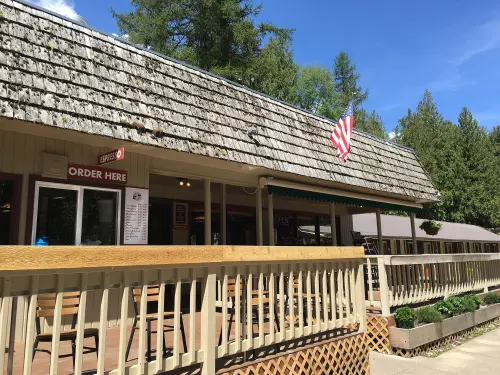
This year at work, besides innovations in design, other changes occurred. First, they opened a new veranda for us with 6 tables and even a small bar counter. Let me remind you that last year we opened the first outdoor veranda with 8 small (for 4 people) and one large round table (for 6 people). In other words, every year we have a larger and larger flow of people. Even if it's a little bit, the simultaneous number of visitors is increasing.
On the right is last year's veranda. And on the left is the new one. There is also a window to the coffee shop there. True, at that moment the summer zone was not open for lunch, but only the bar counter was available. So don't pay attention to the fact that it is so empty:
But to facilitate work for the entire restaurant as a whole, or rather the service turnover, a new expensive system with tablets was installed. Yes, technology is taking over the world, and instead of outdated notebooks with pencils/pens, Jobs-named tablets are coming, which work from a single system and are united under one Wi-Fi network. In other words, every waiter, when starting a shift, received a charged tablet that had a specially programmed application containing the full menu. A new order for a specific table was created there, new dishes were added to this table, and then the order was sent as a "ticket" to the kitchen DIRECTLY from the table. That is, if previously waiters spent time writing everything down and then went to 2 system computers, entered it there, and only from there sent the order, now all this takes less than a minute and is done without leaving the customers.
This year we no longer had a chef, or rather, only the lead cook Mike remained, and I was the prep cook. Also, of course, John remained, who was a kitchen manager many years ago, missed a year in 2014, and then returned in 2015. Amanda was still the office manager, and Will, who was the company's executive manager, became the director, receiving more responsibilities, so we started seeing him significantly more often. But Brian, on the contrary, less often.
But, to be honest, although I was inspired by the new season, I was still a little wary of one of the new American cooks on the day of my arrival. Meeting me, he asked: "Tell me you're a cook, please!". And he was so glad that I work in the kitchen. At that moment, I just thought that they were short of people and it was logical, and I didn't attach any importance to it. It happens. By the way, this was another lead cook for this season - Trevor from Portland.
In the beginning, everything was really wonderful. Unusual, but as John said, it's like riding a bike: You won't forget it anyway, you just need to remember a little. Gradually, everything was remembered. Although I was very tired, I was still glad to work. Besides, I was put on morning shifts, which I treat quite mediocrely. To be honest, in the kitchen, all shifts are good in their own way: both morning and night. In the morning - you arrive before everyone else, open the restaurant, you can even manage to have breakfast. Even despite the fact that you have to get up early (and in the middle of the season the shift starts at 6 am), by the middle of the shift, considering coffee or Red Bull as well as a bunch of adrenaline, you don't want to sleep at all, and then you are free for the whole day + you don't have to clean the whole kitchen. True, you have to go to bed earlier. Although this does not stop everyone and many go to bed as they want, they just spend more on coffee/Red Bulls later.
In the case of a night shift - you can get enough sleep, there is time in the morning for yourself and any other business. The downside is that they can often call you earlier, thereby breaking plans for the morning. Although for some this is a plus in terms of adding hours. Besides, at night you have to scrub the kitchen. There is no clear schedule there, so the night shift hours are not fixed - they can finish at 10 or 12 at night, depending on when the restaurant closes, and then how long it takes for the staff to scrub the kitchen.
A middle shift may seem ideal in terms of not having to get up early or clean up at the end of the shift, but it kills all your plans for the day. You have neither a full morning nor a full evening, as you will work somewhere from 11 am to 7 pm, etc.
I always preferred the night shift more, as I started with the night shift from the very beginning and have more experience there. I was always ready to scrub the kitchen after the shift, but not ready to get up so early.
Unfortunately, later we started having difficulties. Or rather, the main problem of the whole season, which entailed a whole series of problems in the kitchen. Here, a small corner of lectures on how to and how not to run a restaurant business practically opens. So, considering that the restaurant continued to expand and develop technologically, but nothing was done in the kitchen except for the design. Oops.
What did this lead to? To the fact that with the new veranda, there were more orders, and with the new technology, orders began to arrive several times faster. Why? As I explained above, the waiter can send a ticket without leaving the table. And imagine that in this way, the waiter walks from table to table and makes orders in a row. And the tickets are printed and printed, queuing up in our printer and on a special shelf at the middle "position" on the line. Here the catastrophe begins when we have 20-25 orders in the kitchen. And they keep coming, you know?
This, of course, did not reach the management, or rather, they thought that the problem was us. Since last year everything was under control, and this year they improved the ordering system so that they arrive faster, and only from adding 6 tables we get so weak every day at lunchtime, or rather at 1-2 pm. Undoubtedly, immediately, most of all, they demanded from those who have been here for a long time, or rather from me and Mike. Demanding not just to improve work, but even explanations: "Why are people waiting for orders for 40+ minutes, when the norm is no more than 20?" And the thing is that it is also difficult to gather on the line in difficult moments, so everyone just started to get nervous instead of helping each other.
That's how, actually, this season began. With such a seemingly small thing that led us like a snowball deeper and deeper into nerves, failed orders, as well as dissatisfaction from managers and customers.