Our work routine didn't start right away. Mid-June in America is still the "off-season"; students are in school, and resorts are empty.
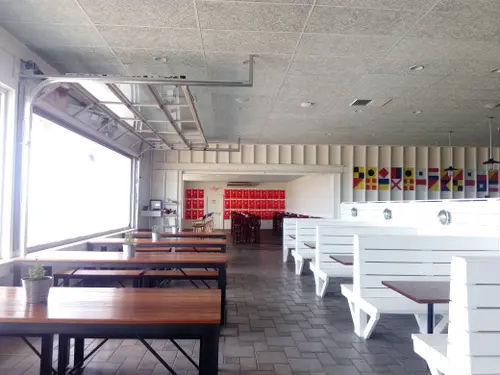
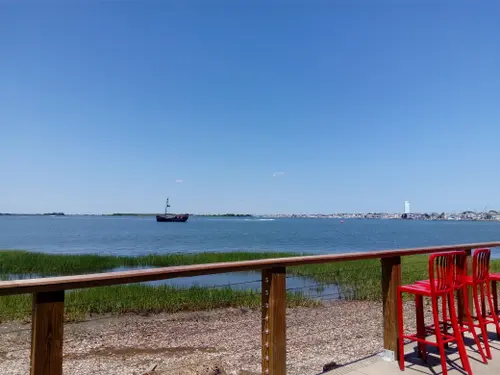
A restaurant that agreed to hire three Russian students turned out to be a trendy spot. It had a panoramic view of the lake and the setting sun, typical American cuisine (sandwiches, french fries, steaks, and local fish), a huge dining room, and a kids' play area. All three of us had offers for the kitchen as cook's assistants, but only Misha was sent there—Yulia and I ended up as bussers.
First encounter with the workplace
View from the restaurant terrace
A busser is a waiter's assistant. Their duties include walking slowly between tables to find an empty plate or glass ("Excuse me, are you done with this?"), taking them to the dishwashing area, and cleaning the table after guests leave. You are also constantly asked to bring salt or call a waiter, but those are minor things. Overall, it's not a back-breaking job.
Misha, meanwhile, was cooking full-time in the kitchen. No medical certificates, no gloves or hairnets—in the States, they are much more relaxed about hygiene (perhaps it's different in big cities). So, after this summer, we both know who will be the home cook in the family...
The perks of our positions were also different. Working in the kitchen meant terrible heat, constantly cut fingers, interacting with a micro-colony from Puerto Rico, and unlimited access to food—as you can imagine, the latter REALLY cut our expenses. However, the kitchen hated weekends—with a tenfold increase in workload, their pay didn't change at all.
The busser position was, perhaps, more pleasant. You had to force a smile, carry heavy loads, drop plates, act completely clueless in conversations with guests, be on your feet constantly, and on busy days, run for hours without stopping. But the tips were directly proportional to the workload, and we mostly interacted with American waitresses.
Everyone was friendly to us—but only as much as social etiquette requires. The restaurant manager politely thanked us for the souvenirs from Russia without even opening them; waitresses could chat with you very nicely one evening and not even say hello the next day. Whatever they were discussing, the same cliché words always sounded: "Cool! Amazing! Great! Oh, it's so much fun!". And everyone smiled that strange "work" smile that you will never see in Russia. We were required to do the same. On the very first day, the boss said: "Smile, girls, you're not in Russia anymore. Smile or I'll fire you".
At the end, he added a smile—so it was a kind of half-joke.
But in general, everyone was friendly. My parents' fears about prejudice against Russians in the States were completely unfounded. First of all, America is a country of immigrants, and Russians are clearly not the smallest nation there. Besides, most people were simply unaware of political news—Americans are not very interested in the outside world, especially one so distant. Their news doesn't make us "enemies of the people"—they just don't mention Russia. Those who had an idea about the complicated relationship between the two states expressed sadness about it, but never aggression.
But back to work. As I already mentioned, in the first weeks, up until July 4th, there was... no work. We came to the restaurant two or three times a week (it turned out to be about 12 hours, not the promised 40), worried a lot about our budget, and desperately looked for a second job.
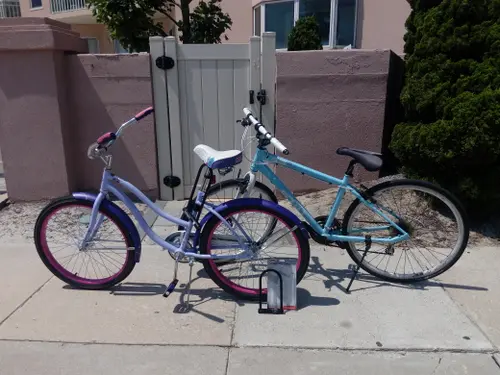
Your most loyal friend and main assistant in finding a job
It seemed that searching on the spot would be much easier than searching from across the ocean. But that wasn't the case... The city was just waiting for the influx of tourists, and extra hands were truly unnecessary. We visited absolutely every establishment in the city—and again, only one place agreed to take us.
More precisely, a bakery agreed to take Misha, and Yulia and I got jobs as maids at a hotel. From that moment on, work became our everything.