What is a "Job offer"? Why is it needed? Where can you find one?
Hello, dear reader! This article describes my personal experience of looking for a job in the USA: what services I used, what difficulties I encountered, what is important and what is not when searching for a job; is it possible to find a job offer if you are going on the program for the first time?
A Job offer is an official employment proposal from an employer to an employee, specifying all essential terms of the future employment contract: position, salary, conditions, work schedule, guarantees, benefits, etc.
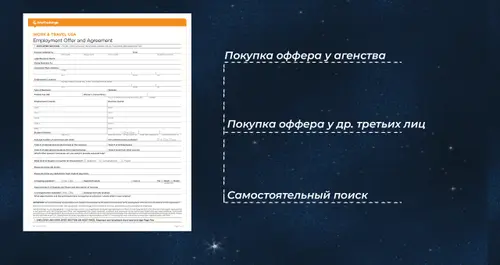
A Job offer for InterExchange is a two-page document stating: the employee's full name, the employer's name and address, employer contact details, salary, the number of hours provided by the employer, a description of the employee's duties, and information regarding the availability of housing for the employee. These key points are very important, which is why they must be read and verified to avoid future problems regarding work matters. Also, pay attention to the checkbox for employer-provided housing. If it is checked and the employer provides you with housing, then upon successful confirmation of the offer, you don't need to look for anything else. If there is no checkmark, you need to find housing in advance, because at the consulate they will most likely ask where you will live and ask you to explain all the nuances: how much the housing costs, whether it is far from the workplace, how you found it, etc.
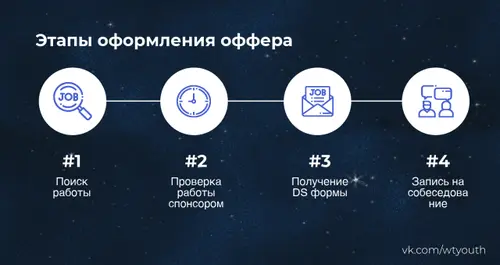
After you receive a Job offer, you must upload it to the sponsor's website, in my case, InterExchange. After uploading the offer, the sponsor checks your job to see if the working conditions match the program requirements. During the verification process, the sponsor contacts the employer by phone and re-confirms all terms. If the job meets all requirements, the offer is approved.
There are several ways to get a Job offer:
- purchasing a Job offer from the agency through which you are processing all documents;
- purchasing a Job offer from third parties offering their services (friends, VK communities, websites, etc.);
- searching for a Job offer independently.
In my first year of participating in the program, I immediately ruled out the options of searching for a job independently and buying an offer from third parties, as I was inexperienced and afraid of being scammed. I bought an offer from an agency for $300. It went something like this. They showed me the available job offers, told me about the workplace and salary, asked about my expectations, and recommended an employer accordingly. Then I paid $300 in cash and never thought about the offer again. The agency sent the documents to the sponsor themselves and controlled the offer validation process. Later, I received a notification that the offer was successfully confirmed and I could be at ease.
Advantages of this method:
- ease of processing - you don't need to deal with documents or communicate with the sponsor in case of problems;
- no fraud - by buying an offer from an agency, you get guarantees that the offer will successfully pass verification, it won't be rejected by the employer, and upon arrival, you will get what was written in your contract;
- verified employer - often the agency has been cooperating with employers for years, so they can tell you about all the nuances of the work that were identified by previous program participants;
- in case of any problems, you can always contact the agency;
- offers offered by agencies are standard, which is why the consul will have fewer questions about your work in the USA.
Disadvantages of this method:
- you have to pay for the offer;
- lack of flexibility - often the agency has a limited set of standard jobs in standard places where you will meet many exchange students just like you, which, by the way, will complicate finding a second job;
- often all offers offered by the agency include a clause about mandatory residence in the housing provided by the employer.
Thus, we can say that this method is perfect for beginners, as well as for people who do not like to experiment. You will get a standard, verified job and housing, as well as peace of mind regarding your future summer.
Next, let's talk about the second and third methods.
The second and third methods I combine, as I would like to consider them using my personal example.
A little backstory. Returning from the USA in the fall of 2017, I firmly decided that I wanted to go again and that this time I would try to do everything myself and minimize the costs of the document processing process.
I decided to look for work on the Internet. I read and watched videos on how other participants did it, and started searching.
- Craigslist.org and other sites.
Craigslist is the American equivalent of the "Avito" site, where users sell things and look for services. Often on this site, you can find quite good job offers. You type in the vacancy, the city, click "find" and analyze the results. Each ad describes the proposed job and provides direct contacts for the person who posted the ad.
On other sites, the principle of operation is similar.
Having compiled a resume, I began to open hundreds of such ads and sent a pre-prepared text to employers by email. By my calculations, I sent about 70 such letters. And I started waiting for an answer.
The results were not the most productive. About 10% of employers replied to my letters, half of whom asked to call them on a mobile number and discuss all the details in a live conversation. This did not suit me. The remaining number of employers either suggested meeting in person at their office or said that they do not work with foreign students and this is their first experience.
In general, such a job search did not give me any results. Since American employers often do not know about the existence of the Work and Travel program (if you are looking for a job in a non-popular place; I was looking in California) and do not want to bother with additional documents.
- I want to note that "Craigslist" is an excellent site if you are looking for a job or housing and have already arrived in the states. This site has helped me out more than once. Therefore, I advise you to save it in your bookmarks and leave it until the summer.
- Offer sellers on VKontakte
Not having received what I needed, I decided to purchase an offer on VKontakte from people who had been doing this for more than one year and had reviews and experience. It seemed to me that such a deal would be more profitable than buying from an agency, and I would be able to save at least a hundred bucks.
I wrote to about ten sellers with the same question. I was looking for two offers in the West without housing. To my surprise, none of them could offer me anything interesting:
- all offers were in the East of the USA;
- almost all of them were in popular cities for J-1;
- in 80% of them, you had to live in the employer's housing.
What surprised me even more was the price. It started at $300 and ended at $500! That is, there was no talk of any economy, the offers were often more expensive, and this was argued by high salaries and good places. This did not suit me at all, and I continued to look for work on my own.
- Job search via maps
Another method I had heard about was searching for a job via maps. The mechanics are simple - you open Google maps or Apple maps, find a small town or village, find various cafes, restaurants, shops there, and write to employers by email.
In general, it was even easier than searching for a job via "Craigslist". You open maps on your computer, then open 30 tabs in your browser with various establishments and write a template letter to everyone in a row.
There were more responses compared to Craigslist. Employers, especially hotels, replied to emails, asked something, asked to tell more about themselves, etc. - in general, there was interest. But, unfortunately, this interest did not grow into something more, and not a single employer wanted to hire me remotely. Some did not work specifically with InterExchange, and some did not want to deal with sponsors in principle. The maximum I got were promises to hire me immediately upon arrival in the States.
Thus, this method, although it collected feedback, could not solve my problem with finding a job. Perhaps I should have spent more time, or perhaps I was just unlucky.
Summing up, I want to say that I did find a job myself, but it took me about a month. In the end, I came up with my own search method, thanks to which I managed to find an offer in California without housing. And now I would like to note that looking for a job in the USA is a more tedious than difficult process. Luck plays a big role here, as well as the employer's willingness to make contact. After all, for many employers living in small towns and who have never heard of the Work and Travel program, hiring a foreign student is a new and unmastered process. Many of them simply do not want to do this, as they know almost nothing about the student who wants to work, and spending time on paperwork in their eyes may not be rational.
Despite this, I would like to recommend that everyone try to find a job on their own. In the process of searching, you will learn about many new vacancies that your agency might not have offered you, and also get to know the place where you are looking better in general. And even if the search does not end in success, you will know what you paid money for and will treat the choice of an offer seriously, and not the way I did in the first year of participating in the program.
https://vk.com/away.php?to=http%3A%2F%2Fwww.craigslist.org%2F