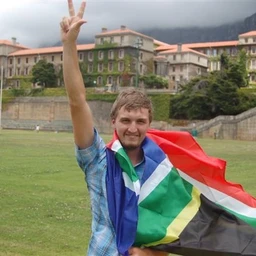
Alexey, Magnitogorsk
«I fell in love with this country at first sight!!!».
Alexey
WELCOME TO SOUTH AFRICA
Ever since I was in school, I dreamed of visiting this mysterious country, completely unknown to most of our fellow citizens. Historically, due to the political regime in South Africa, the USSR (as far as I know) had no diplomatic relations with it for many years. This lasted until the fall of that very political regime — apartheid (from the English «apartheid» — separate living, in this case, based on race). The USSR, however, ceased to exist three years before South African apartheid ended. The new Russia established diplomatic missions in South Africa, and relations began. But Russian citizens, for the most part, still know little about this unique country, except for some stereotypical ideas (as is the case with most other countries on the African continent). So, we have yet to discover the new South Africa!
By the way, this young country will turn only 15 years old in 2009!
And it became new thanks to fundamental changes in all spheres of politics, economy, society, and mentality. These changes have only just begun. The most potentially dangerous times for the country and its residents are now behind us, but this young pearl of the African continent still has many sharp turns ahead.
«Welcome to South Africa!» — a greeting with information about roaming conditions appeared on my mobile phone display as we were flying in, circling over the impressive Johannesburg and O.R. Tambo airport. Through the porthole windows, I saw the skyscrapers of Hillbrow, the local Manhattan... Those were my first minutes and first impressions of the country. Very pleasant impressions, gradually growing into euphoria from the very realization that I was in South Africa!!!
In general, strange thoughts arose even while approaching, as the plane slowly descended first over Pretoria, then over Johannesburg, giving passengers an excellent opportunity to view this entire metropolis from a bird's-eye view. Below, neat farm fields floated by, then suburbs, a kind of «one-story America», then industrial zones, business districts with skyscrapers, golf courses, stadiums, a racetrack, highways... And everything was neat and even. And the thoughts were strange because I was bewildered that all this was in Africa!
And most of our fellow citizens have a completely different idea about the countries of this continent. My thoughts seemed strange to me also because I expected to see South Africa exactly like this! I had read a lot about it and studied it remotely for a long time, but I was still struck and pleasantly surprised.
Next were the friendly black customs officers, pleasant airport staff ready to help. We transferred to a flight to Cape Town, where another portion of impressions awaited us. It was cool that day. The local spring was beginning.
We were quite surprised by the slums (townships) near the road from the airport, «Khayelitsha». Those were the so-called «houses for black poor, illegal immigrants, and all sorts of drifters».
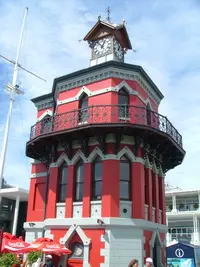
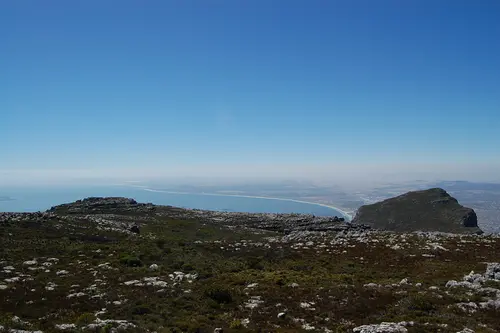
But upon approaching the center, we were surrounded by very cool neighborhoods, drowning in greenery. And finally, the most stunning view opened up when entering the center, on the descent from the mountain. The whole city, the bay, the ocean, Table Mountain... — everything was in full view. Unforgettable minutes of incredible delight, experienced on the first day in Cape Town, the acquaintances of that day — all this made me fall in love with these lands forever.
— Wow!!! I can't believe my eyes! — I marveled, looking around and catching my breath from the delight and joy overflowing me.
Before South Africa, I went to America twice for four months on a student program. It was okay there, but America didn't hook me. Which I cannot say about South Africa.
When the three of us got together: me, Liza, and Alisa, wanting to go somewhere, I suggested South Africa. The girls didn't resist. Moreover, we had just graduated from university, we really wanted to rush off somewhere, and nothing was holding us back, whereas we practically had no chances left to go somewhere else for so long as students. The Russian autumn and winter were looming ahead, while the winter summer in South Africa seemed very tempting to us. However, we were not mistaken.
We set about preparing for the trip with diligence and enthusiasm. Soon we found out and, of course, were very happy that another girl would go with us — Dasha from St. Petersburg. I don't remember who found whom first: she found us, or we found her, but we found each other, it seems, through the CMO chat dedicated to South Africa. Although, maybe I'm confusing something...
And so everything was ready, we gathered, went, and arrived!
After meeting at the airport, we were taken to «Ashanti-house» and settled in. Dasha flew on other airlines and was settled in «SASTS-house», but she managed to get transferred to us.
For the first week, I'll be honest, we were just having a blast! We went on excursions, didn't worry about anything: neither about work, nor did we even think about housing. The need arose later. And immediately, acutely and concretely: we had to move out!
We paid for three days of stay at «SASTS-house» and started looking for housing for further life in the Cape. By the way, you can look for it in three ways: through agencies, through newspaper ads, and through ads on the website (we used www.gumtree.co.za for this).
We looked at, it seems, five apartments and settled on the last option, as it suited everyone the most. We settled in Green Point. After that — let's look for work. In SASTS, they advised us to go to Cubana, and we all went there. Dasha left there first. Then, me. And last were Liza and Alisa. Liza got a job in another place, and Alisa worked until December, after which, a month or so later, she decided to go home. But before that, she wanted to walk around, see the city, and relax.
I got a job as a bartender in a small restaurant on the Waterfront. I worked there for half a year.
Alisa and I broke up, and I met a local girl and started dating her. We met at the restaurant — we worked together.
And then ordinary life began, like any South African's.
For almost eight months that I lived and worked in the Cape, I managed to study the city and its surroundings quite well, regularly making some trips. Either by bus, or by train. Or even by car with friends.
And in March two thousand and eight, I went on a big trip — to Namibia!!!
No one could keep me company: my girlfriend was working, Liza was too. Katya had recently arrived, she wasn't up for trips. And she was also working. Ira flew to Almaty. I thought and thought, and bought a bus ticket to Windhoek — the capital of Namibia.
I traveled for a whole day, on the way I met a German guy, a girl from New Zealand, another one from Israel, and an American guy. We ended up with an incredible vinaigrette: the most amazing thing is that we all met in Namibia!!! We became very close with all of them, especially with the New Zealander, the American, and the Israeli. The German moved on after Windhoek, and we, instead of the originally planned one day in the capital, hung out there for three. In general, as a country, Namibia does not differ much from South Africa, with the exception of landscapes. It is famous for the amazing beauty of deserts.
There are such insanely long highways, disappearing into the unfathomable distance, and no one for tens of kilometers! Do you know why? The population of the country is two million people, and that's for a territory the size of Ukraine! The towns are very small. Windhoek itself is small, and there is not much to see in it. But the main beauty in Namibia, as in South Africa, is its unique nature.
After three fun days in our motley company, we all moved in our own directions. I went to the Cape. I went out to the highway and started catching a car. Hitchhiking here, in principle, is not very common, but, still, I managed to travel part of the way exactly like that.
Most of all in that trip, I remember the road. I liked the movement! To drive and drive endlessly, constantly meeting different interesting people. Namibia is, in my opinion, a fabulous country!
In March 2008, the Russian research ship «Akademik Fyodorov» arrived at the port of Cape Town. We met a professor from that ship and became very good friends with him. In the end, we even exchanged T-shirts, and the professor invited me in the autumn of two thousand and eight on a voyage to Antarctica! I was very happy!
And in November, I left with the «flagship of the Russian fleet» on a voyage. I spent the winter in Antarctica (where, by the way, it is also summer at this time of year, just like in Africa). The coldest weather there during this period was minus ten degrees!!!
In Antarctica at this time of year, it is day around the clock, the sun does not set below the horizon at all. And in their winter, on the contrary, the sun never appears above the horizon. A strange and amazing place! In which, at times, it is unusually beautiful!
Having returned from the voyage, I plan to move, at least for a temporary place of residence, to Cape Town. It turned out that I simply cannot live without this city anymore and I miss it very much! It would be great to spend our winter there, and return to Magnitogorsk in the summer. It's good here in the summer too.
I remember when I lived in the Cape, whether I wrote home or talked on the phone, when the conversation turned to the local population, for some reason, no one understood me. After all, the majority has the opinion that only the black population lives here, and even that treats whites poorly. In addition, they think that it is dangerous and not good to live here.
THIS IS ALL UNTRUE!!!
Personally, I have forever retained a feeling of positivity from the country. In fact, this is one of the friendliest and most welcoming countries in the world! It's not for nothing that they are called the «Rainbow Nation»!
The term «RAINBOW NATION» was introduced by Nelson Mandela. Perhaps one of the greatest figures who has ever been in power and involved in the history of South Africa. And the main of his achievements, in my opinion, was not at all the involvement of the absolute majority in the governance of the country and not the victory over the malicious apartheid. His greatest achievement is the peaceful outcome of all this. After all, for the white population, the arrival of democracy could have turned out very, very tragically. And not only for the white. All the peoples of South Africa would have been involved. And, besides, the integrity of the country and its economic power and well-being would have been undermined, lost for a long time or forever, looted, destroyed in the fire of civil war. Then, in nineteen ninety-four, the country was almost under martial law. People still remember this well.
My good acquaintance, Marina Scheffers, a colored South African, recalled those years: «The population was intimidated. Grocery stores were being bought out. They were stocking up on food in anticipation of, if not a war, then an economic crisis. Since 1989, apartheid began to gradually burst at the seams, it was clear to everyone that white power would soon end. Before that, explosions regularly thundered in the country, terrorist attacks were carried out. All this was the work of the military wing of the opposition party ANC (African National Congress). A black party, now having the majority of seats in parliament, and effectively being the ruling one. The white government, of course, did not remain in debt. People were put in prisons, beaten, brutally suppressed any manifestations of protest, sometimes simply physically destroyed. The most scandalous episode is the suppression of the uprising in Soweto in 1976. Then the police extremely brutally suppressed the uprising of black schoolchildren in this black ghetto of Johannesburg. There were many victims. The students rebelled against the complete transition of education in schools from English to Afrikaans. A quite reasonable and harmless reason. Since the apartheid regime tried with such actions not so much to instill a single national language, Afrikaans, in the country, as to isolate the future opposition, weaning it from the globally widespread English.
By the way, it is an interesting fact that white South Africans were also members of this military wing of the ANC and the party itself at that time. Of course, under the cover of secrets and conspiracies. The party was completely outside the law. Many whites provided support to the militants. Some even organized the transport of weapons from neighboring countries on tourist buses. Right with tourists on the buses, machine guns, explosives were carried... Now, however, among the ANC, white party members can be counted on the fingers of one hand. But, fortunately, all this is now behind us. The apartheid regime peacefully went into the past. Thanks again to a no less important figure — Frederik de Klerk. He was the last white president of South Africa. At least, of the old South Africa. The old power and the new, under the supervision and pressure of the world community (on the old power), did not allow bloody chaos in the country. Evolution occurred, not revolution.»
Who exactly are the whites, coloreds, and blacks? Whites are predominantly Afrikaners (or Boers). This is the people who created the country as we can see it today. They are only 13% of the population. But this, at one time, turned out to be enough to create a country with a Western economy and infrastructure, which belonged to one of the eight most developed countries in the world. The national currency, the Krugerrand, was on par with the dollar. The British pound was worth three rand.
Boers created highways, skyscrapers, enterprises, and kept the remaining 87% of the population «under the boot». This was possible solely because South Africa was the most police-state in the world. With the strongest army on the continent.
The language of the Boers is Afrikaans. It comes from Old Dutch, then mixed with English, Xhosa, and transformed gradually into what it is now. Dutch and Afrikaners can still communicate with each other, although with great difficulties in mutual understanding. Afrikaans is also not homogeneous. There is high Afrikaans, there is black. Educated whites speak the high one, they teach at universities. It is spoken, mainly, in the interior regions of the country. Many residents of Cape Town, including whites and the colored population, speak «black» Afrikaans. High Afrikaans is more Dutch in its phonetics and grammar. The Afrikaans of coloreds seems to be a completely different language and sounds interesting, as they have a manner of speaking in a sing-song voice. Besides the language, the Boers are distinguished by the fact that they created the most wonderful wine in the country. More precisely, they didn't create it (French Huguenots started winemaking) but preserved and developed it. Their national music is country in Afrikaans. They are all bilingual (Afrikaans and English).
Under apartheid, whites had everything, and the rest were largely deprived. And now, it seems, it has leveled out, but even now some «dark spots» remain. Democratic dogmas under the leadership of incompetent rulers in reality often turn into the collapse of successful countries, as happened with neighboring Zimbabwe. This did not happen with South Africa. Here, for now, a transformation is taking place. Attracting blacks, pulling them out of the bottom. However, those who have come out themselves and even become rich are not in a hurry to pull out their black brothers. It is unknown where all this will lead. Often it seems that this is not a transformation, but a sunset. But South Africa, like Russia, no matter how they broke it, especially from the inside, does not break...
Among the white population, there is a part of the British by nationality. During the time of apartheid, they also partly had to tighten their belts. The truth is only in the issue that the state language was Afrikaans and only Afrikaans, not English. But now there are as many as eleven official languages: English, Afrikaans, Zulu, Xhosa, Sotho, Sesotho, Ndebele, and some other local ones. Democracy...
Former Russians and Soviet citizens strive for conservative Boers. The largest Slavic diaspora in South Africa is in Johannesburg. There is also an Orthodox church — the Cathedral of St. Sergius of Radonezh, built with the money of the diaspora.
The overwhelming majority of whites here live in a European way, live in separate, predominantly «white» neighborhoods... Our immigrants join them. Some also live in mixed neighborhoods, those who are poorer. However, some local whites, apparently from living on the African continent, still lost their minds... Such representatives stand out from the crowd. They emphasize their joining the «Rainbow Nation». They usually look like this: necessarily tanned to a dark brown color, wear traditional African hairstyles, sometimes even live or often visit townships. It is worth noting that such a trend has begun to be observed only over the last years of democracy. Many local whites emigrated to Australia, New Zealand, the USA, Canada, Britain, but more and more Europeans are moving here from various countries. Recently, even those who left here have begun to return — a positive sign, indicating, after all, not a sunset, but a transformation.
One of my friends had his whole family move from Britain to live in Cape Town. A risky step, it would seem: in Britain, the standard of living is higher and it is safer to walk the streets. But they were rewarded quite a bit — with the money from one London house, they purchased two mansions here. One — on the ocean shore, the other — in a village two hours by car from Cape Town. The tax burden also does not press as much as in Britain. The climate is an order of magnitude more pleasant. And much more free time. After all, South Africa is one of the few countries where you can achieve success in business or just work in a qualified specialty without overstrain and nervous breakdowns. There is simply a sea of opportunities here! Both for business and for a happy life.
Coloreds are, in my opinion, the most interesting part of the South African population. Coloreds are different. There are those who descended from the mixing of races, and there are those who simply belong to non-white and non-black nationalities. The majority are Indians. How did they get here? Back in the British Empire, when it was necessary to service the sea route to India through South Africa, many of them settled here. Then they were slaves. A large part of their diaspora lives in Durban. This is, perhaps, the most Indian city outside of India. Their culture is colorful, and the national cuisine adds many bright colors to the «Rainbow Nation». But you can no longer call them Indians. They have not preserved either the culture or the language. And few of them have ties with their historical homeland. They have long become South Africans. And this, nevertheless, is more good than bad.
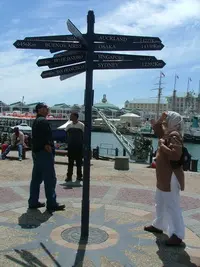
Besides Indians in Durban and throughout the country, there are Malays in Cape Town. Muslims. Sometimes it may seem that you are in an Arab country: women in burqas are not such a rare phenomenon.
White former Europeans, most often, move by car. Therefore, coloreds and blacks create the picture of the streets. There is a Muslim district Bo-Kaap here. There are also Chinese, Koreans, Japanese. But their diasporas are poorly expressed.
The most interesting coloreds, in my opinion, are precisely the mixed coloreds. Their language is also Afrikaans, for the majority. Their culture is interesting, but lost between Boers and blacks. This is a real cocktail! Coloreds live, mainly, in their own neighborhoods, but still, most of them live mixed with whites, but less often with blacks. Colored women are quite attractive, and men are prone to choose colored and often — white. The so-called «whitening instinct» is a joke that exists among the people.
Many coloreds feel lost between two fires. However, both under apartheid and now, coloreds are on the sidelines of political life in the country. It is also characteristic for them to live in separate neighborhoods based on race — another relic of apartheid that has taken root in this country.
If we take the black population — it is a motley mosaic of peoples and cultures. The story could be expanded by 75% more than about all the others. This is not a single ethnic group and not quite one nation. If you list the main ones, you can mention the following: Xhosa, Zulu, Ndebele, Tswana, Sotho, Sesotho. The most famous to the world community are, of course, the Zulu people. They are distinguished by, let's say, an active position in the historical arena. This was a warlike people. They had their own state when the British came to their land. And they resisted, which, if you recall colonial history, was not very common among African peoples of that time. Historically, it so happened that the Zulus were hunters.
And in our time, they are again the most active representatives of the black majority of South Africa. They manifest themselves in politics, economy, culture, art. In addition, they are the majority among the black population, and the Zulu language is one of the most common in South Africa. They live mostly in the east of the country. Including in the capital Pretoria and in the metropolis of Johannesburg. In contrast to them, one can present the Xhosa people. They inhabit the western part of the country, in particular the Western Cape province. Historically, it so happened that the Xhosa tribe belonged to the group of gatherers, not hunters. This significantly influenced their national character. Xhosa is not a warlike tribe. Rather, it is a very peaceful and quiet people. With a not at all active life position. Most of them do not strive to change the current state of affairs and their social status. However, their culture is very interesting and peculiar. Take at least their «clicking» language. One of the most unique languages in the world in its phonetics — clicking sounds that are used for different purposes in almost every word. A very noisy language to perceive. You won't be able to sleep on the bus on the way home if Xhosa people are traveling nearby.
However, despite their peace-loving and little-concerned majority, it was from this people that many of the brightest and most active political figures who created modern South Africa emerged. Nelson Mandela alone was worth something! Thabo Mbeki, the last president of South Africa, also belonged to this same tribe.
An interesting fact from the life of both figures, related to the traditions of their people. Among the Xhosa, even now there are a kind of unique rites of initiation (dedication of a youth into a man). A youth must go for a long time into the bush (wild shrubs, steppes), completely alone. After a certain time of wandering through the wild bush, the youth comprehends the truths of the universe, the price of life, and becomes a man. He returns, painted from head to toe in white. Such rites in Xhosa communities are conducted even at the present time. Of course, mainly not in those communities that live in the suburbs of Cape Town. So, an interesting fact is precisely that neither Nelson Mandela nor Thabo Mbeki underwent the initiation rite.
Another curious fact from the history of South Africa: there has always been and exists mutual dislike between the Xhosa and Zulu peoples, if not enmity. Historically, it so happened that the Zulus dislike the Xhosa for their backwardness and lethargy in all respects, and the latter cannot stand their enemies precisely because they dislike them.
And how did Mandela become the «father of the nation»? It is quite curious that he managed to inspire even the «unruly Zulus» to follow him. With Thabo Mbeki, long before the actual end of his presidential term, a slightly different story happened: he was literally forced to leave the post of president last year. The official reason is fraud, or something of that kind, carried out by the president. But politics is politics — who can figure them out there?! The initiators were supporters of Jacob Zuma, a Zulu by nationality. However, a whole series of completely different stories is connected with the latter personality. I will not go into them. I have already delved enough into politics.
There are other less numerous peoples that make up this motley mosaic of the «Rainbow Nation». Ndebele, Tswana... to be honest, I haven't even remembered them all yet. Many of these peoples also live in neighboring countries — Zimbabwe, Botswana. This is used by numerous illegal immigrants (blacks), who have literally flooded the country, which even without them is bogged down in unemployment among the black population.
But this is just by the way. And if you just look at the indigenous Africans, and at the entire population of the country in general, you will get a most unique and beautiful mosaic of different cultures, languages, traditions! Just a beautiful mosaic! It is not for nothing that South Africa is called the pearl of the continent! And the people largely made and are making it a pearl. For which, to the people, thank you!
And to future travelers, the most pleasant impressions and a successful time!