04:30, November 25, 2008. It is becoming a habit: switching off in the evening, getting up at night and engaging in... life. What surprises me is that the city doesn't seem to be going to sleep! In principle. Even when I'm driving home from work at five in the morning, there are enough people around who seem to have forgotten that sleeping is normal. It has become normal not to sleep. How unlike the Russian winter this is. What can one do on long, cold evenings back home? Read. Watch TV. Work. Sleep. And in the summer, to be honest, we don't sleep much either, especially in the center, somewhere on the pedestrian Kirovka. It is so beautiful, romantic, and modern not to sleep, but to enjoy life. Only, unfortunately, neither in Africa nor in any Russian megalopolis are night strolls as safe as in quiet and peaceful Europe. This is something we should also strive for. And now, for example, in the apartment where I live next door to Shane, he is sitting in the living room with his friends. They are watching TV, chatting, and seeing me, they also started doing laundry. I often see that they sleep during the day. But rarely at night. Sometimes I wake up at nine or ten in the morning, and they have fallen asleep in the same positions they were sitting in at night. Funny. What I like is that they are not noisy and don't drink like devils. Sometimes a little bit, but it's somehow harmless.
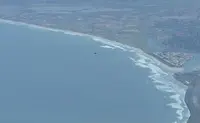
Today (or rather, yesterday now) I had my baptism of fire. My first swim in the Atlantic on the South African side! I was lucky, I have been to this ocean from different sides: from the American side and from the European side.
And yesterday we went with Stas. The water, for the first time for me in the Atlantic Ocean, was cold. But everyone says it's always like that here and no changes are expected. There you have another wonder of the world. Africa, summer, and the water in the ocean is low-temperature. It doesn't make sense, does it?! But everything is logical — the current from the Antarctic. And if you want it warmer, then you need to go to the Indian Ocean! And it's almost three hours away by transport. Probably the closest place is Cape Agulhas. Geography claims that this very cape is the border where the two oceans meet. They say the difference in water temperature on the right and left sides of the cape reaches ten degrees. It would be interesting to visit there. Well, maybe I'll get lucky. I'll hope!
And if you have heard that the place where the two oceans meet is the Cape of Good Hope, I dare to assure you, that is a fairy tale for tourists!
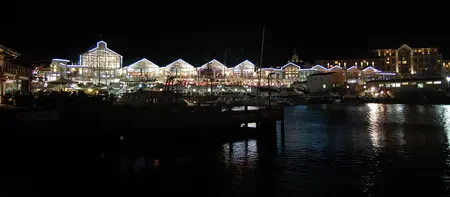
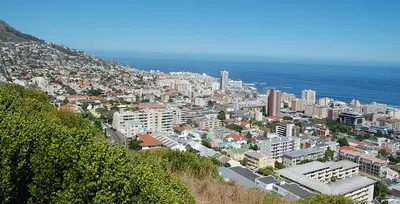
But there is another interesting fact already connected with the "Good Hope" cape: it was from there that the history of the city began. And with Cape Town began the history of today's South Africa. For many, it is associated with the name of the Portuguese Bartolomeu Dias. There is a monument in his honor at the cape. I saw it, we drove past it on a bus at a distance of about one hundred and fifty meters. I will perhaps quote a part of the article "Walks through old Cape Town" by Apollon Davidson (dug it up on the Internet). It is written so fascinatingly there: "The old harbor. This is the one from the song of my childhood: 'In the port of Cape Town, with a hole in the side...' A few years ago, the old port was transformed. For a long time, Cape Town was called a 'seaman's tavern at the junction of two oceans.' Now the whole port has become a tavern, almost in the literal sense of the word. In the port facilities, there are cozy cafes, small restaurants, beer halls, attractions. In the old dry dock, there is a two-story row of shops. On the square, where previously only drunken sailors shouted, artists perform. However, in the evenings, they still shout here. Looking at the festive crowds of tourists, it is not easy to imagine with what difficulty the first navigators reached here. Colliding with each other, the waters of the Atlantic and the Indian Ocean are rarely calm. Even the most experienced skippers crossed themselves when they managed to reach the harbor safely. News of killer waves at the southern tip of Africa spread to all the harbors of the world. They were called 'Cape Rollers.' How terrible they were for sailing ships, if in 1974 a wave fourteen meters high broke the bottom of a large English dry cargo ship. And a few years earlier, a wave broke in half one of the first supertankers in the world with the loud name 'World Glory.' This path was also difficult for the largest squadron that ever passed here. And that was a Russian squadron. 1904. Past Cape Town, one after another, went the battleships 'Suvorov,' 'Alexander III,' 'Borodino,' 'Oslyabya,' 'Oryol,' the cruisers 'Aurora,' 'Dmitry Donskoy,' 'Admiral Nakhimov,' the transports 'Anadyr,' 'Meteor,' 'Korea' and 'Malaya,' the floating workshop 'Kamchatka' and a second ship named 'Oryol' — a floating naval hospital. It was St. Nicholas Day, December 6 (19). A gun salute was fired in honor of the name day of Nicholas II. They admired from afar Table Mountain, at the foot of which lies Cape Town. The next day, having rounded Cape Agulhas and finding themselves in the Indian Ocean, they ran into a storm — so frequent in these places. The battleships scooped up several dozen tons of water at once, the transports and cruisers tilted by thirty to forty degrees. In the Cape Town newspaper 'Cape Argus,' a letter soon appeared. It was found in a sealed bottle on the shore of the Cape of Good Hope. Written in Russian: 'May the fishermen who might find and read this letter pray for those who are being sent to their deaths, and for this terrible war with... to end soon.' What war? The Russo-Japanese War. Admiral Rozhestvensky's squadron was heading from the Baltic Sea to Tsushima. After a few months, almost this entire armada perished. To this day, only the 'Aurora' has survived. Although then, near Cape Town, it also suffered thoroughly. Connected with this sad event is a story that began quite romantically. The favorite brother of Alexander III, Grand Duke Alexei Alexandrovich, fell in love with the maid of honor Sasha Zhukovskaya. The history of their relationship is not very clear: in those days, no more was known about the private life of members of the royal family than later about the private life of general secretaries. Whether he managed to marry her secretly or not. Courtiers wrote later that the girl was allegedly the daughter of the poet Zhukovsky, and that they allegedly even had a child — and named him Count Belevsky. Such an unequal marriage, of course, looked scandalous. And the father, Alexander II, sent his son on a round-the-world voyage for two or three years so that he would have time to come to his senses. On July 3, 1872, the 22-year-old Grand Duke arrived in Cape Town. The same newspaper 'Cape Argus,' in which they later wrote about the bottle with the Russian note, solemnly reported: 'The long-awaited imperial squadron with Grand Duke Prince Alexei on board has arrived in Table Bay.' The squadron consisted of the frigate 'Svetlana' and the corvette 'Bogatyr.' They were commanded by Admiral K.N. Posyet. He knew Cape Town well: he had been here in 1853 on the frigate 'Pallada,' was friends with Goncharov, who described this voyage in his essays. During the three-week visit of the Grand Duke, the Cape Town newspapers were full of reports about a luxurious ball in his honor, about a magnificent banquet on the 'Svetlana,' about a gift he presented to the wife of the Cape Town governor-general from the Russian empress. About an expensive necklace he gave to one of the Cape Town socialites — already from himself. They were guessing: for which St. Petersburg beauties he was buying ostrich feathers — they decorated ladies' hats with them back then. The interest in all this luxury and the romantic figure of the young duke was also fueled by the fact that shortly before his visit, rumors spread about the appearance in Cape Town of a 'mysterious Russian princess' exiled from Russia. All this was described by the same 'Cape Argus.' On August 31, 1995, in the old fortress of Cape Town, there was — I don't know what to call it — a parade, a performance, or, in the language of our great-grandfathers, a feerie. The fortress is indeed old. Dutch soldiers and slaves brought from various countries of Asia and Africa built it from 1666 to 1679, thirteen years. Now it is a museum. After some alterations, it was reopened. The celebration was timed to this. In front of the invited guests, among whom I was lucky enough to be, troops dressed in Dutch uniforms of the second half of the 17th century showed their skills. They marched, regrouped. Old commands sounded. The orchestra played marches of old times. The parade in the fortress reminded of those times three hundred years ago. But they also told me about a much more magnificent celebration. It was celebrated right here, in the old harbor and in the fortress. And it was connected with the end of the time when: The seas still hid their secrets... The Southern Cross was formed from sultry stars, And the algae of the hidden depth Guarded the secret of these places... Not only in antiquity, but also in the Middle Ages, Europe did not know where the Black Continent ended. Here, where I now walk in the mornings, no white man's foot had stepped. In Europe, they were still waiting for this. And it happened. The completely exhausted sailors saw the southern tip of Africa. A desperate captain was found. He led the ships to those unknown places. And reached them. A joke? — back then it was probably an event no less significant than for us — a man landing on the Moon. Most likely, even greater. We have somehow gotten used to sensations. And the name — Cape of Storms — was invented by that man. The Portuguese captain Bartolomeu Dias (we used to write — Dias). In 1488, when Dias returned to Lisbon, the King of Portugal, John II, changed the name to the Cape of Good Hope. For him, it was the hope that it would be possible to get further — to India with its coveted riches. Alas, Dias with his own fate sort of justified the original name. He died during his second voyage around Africa — again a storm at that cape. The renaming did not save him. But that happened in 1500. And then, in December 1488, one can imagine how Lisbon rejoiced! Whether it was like that or not quite like that — but what romance surrounds those events! Five centuries later, the anniversary was celebrated — at the cape itself, in Cape Town itself! At the tip of the Cape of Good Hope, they placed a monument made of white stone with a cross on top. A caravel arrived from Lisbon, a copy of those that were considered five centuries ago the last word of Portuguese shipbuilders. Bartolomeu Dias once led such ships. The interest in the celebrations was fueled by South African Portuguese. After the mid-1970s, with the collapse of the Portuguese empire, half a million Portuguese flooded into South Africa from Angola and Mozambique. They felt like exiles, and the memory of the former glory of their compatriots — navigators and explorers — encouraged them, helped them gain self-confidence. True, there was an embarrassment with the caravel. They forgot in Lisbon how to make medieval caravels, or it was some coincidence, but it failed to do what Dias once accomplished. It could not complete this entire journey under sail. They had to use modern engines (they were installed on the ship just in case). Of course, it approached Cape Town itself under sail, and they tried to hide the embarrassment. But then again, not all secrets become obvious." Fascinating? Very! Isn't it?! 6:30, can't sleep!